Follow me on Twitter

  • The original phase only took 10 ⁻43 seconds RT @channel4news Creation of the Universe in under 60 seconds http://bit.ly/bUIKAy 5 hrs ago
  • This BBC2 show about E numbers in food is a bit like a Tesco Value version of "The Supersizers Go..." series. 5 hrs ago
  • Scottish minimum pricing for alcohol will save the NHS £5.5 million per year - at a cost of £140 million to consumers. Sensible? 6 hrs ago
  • More updates...

Take a trip in a 1938 tube train

Events and Tours, transport issues

Unexpected – as the poor thing has been rather ill recently – but the lovingly restored 1938 era tube train will be taking trips along the tube network in a couple of weeks time, and you can be on it.

Inside the carriages - 2

I’ve been on it quite a few times in the past – and it is a lovely trip to take, not just for the train itself with its art-deco interior and 1980s adverts still in place, but also the joy of watching stunned passengers on the platforms as you pass various stations in the old train.

There are five trips on Sunday 12th September.

£25 – 8:50 Ealing Broadway to Harrow on the Hill

£25 – 10:26 Harrow on the Hill to Amersham (via the North Curve!)

£15 – 11:30 Amersham to Watford and back again

£20 – 12:57 Amersham to Harrow of the Hill and back again

£20 – 14:30 Amersham to Harrow on the Hill

You also get free trips on the lovely Sarah Siddons, subject to spare seats being available (normally costs £5).

All tickets should be purchased in advance through the Online Ticket Office online (warning - based on previous experience, use Microsoft Internet Explorer to book tickets) or over the phone on 020 7565 7298.

In addition, free heritage bus service will run every 15 minutes between Amersham Old Town and Amersham station.  This service will link you to the variety of activities taking place as part of their Heritage Day, between 11am and 5pm.

5 Comments

Visiting Roman ruins hidden under a London street

Events and Tours, History

Hidden away from sight in a side room next to an underground car park is one of the more important remains of the old London Wall that actually dates from before the wall was built.

When the Romans first started to settle in London (Londinium), a garrison fort was built to the North West of the town. Built with stone walls, it is thought to have had four gates and a barracks for around 1,000 soldiers.

When the London Wall was built around 80 years later, two sides of the fort were incorporated into the Wall and strengthened. Eventually, the two inner walls of the fort were lost, leaving just the London Wall with its famous gates. The northern gate into the former fort became known as Cripplegate.

However, the western gate was lost to history for some reason, and wasn’t rediscovered until the 1950s.

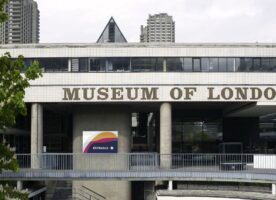
It was to see the remains of this gate that had me wandering over the Museum of London for one of their occasional tours of the site.

Next to the museum – as I am sure you know – are some remains of the London Wall, although most of what you see is actually medieval and Victorian repairs to the wall. King Henry II add the towers and the Victorians used the wall as a “free” fourth wall for warehouses to cut down on building costs.

What we were to see though is totally Roman.

Going down the ramp that runs next to the wall – and avoiding the taxi driving the wrong way down a one-way street, there is a rather nondescript alley under the road leading to the car park, where you might notice a locked door marked private.

The unassuming entrance

In here lies the remains of the Western gatehouse.

A rather musty smell inside adds to the atmosphere, but is due to the rainwater drains in the road above leaking into the room, and is nothing to do with the ruins themselves.

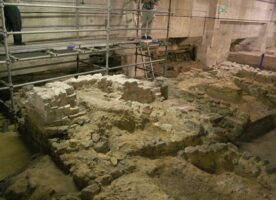
What has been excavated is part of the wall, the gatehouse and the remains of part of the arches that marked the entrance to the fort itself.

Image1

The gatehouse had two arches – presumably one side for inbound traffic and the other for outbound – but for some reason, one of the arches was blocked off at some point very early in its history. It is possible that the blocking of the gate is part of the reason why it never became one of the city’s major gates – Ludgate, Newgate, Aldersgate, Cripplegate, Moorgate, Bishopsgate, and Aldgate, although no one is really sure about this.

The remains of the gatehouse

We were also shown the post hole which would have held the upright pole that hinged the main gates as well as the flat runner for the portcullis.

The main post hole stone

Also noticeable is the entry stone for the gatehouse, which has been worn down by people walking over it. The two groves are probably from two bolts that went down into a hole in the stone to lock the doors. Over time, the bolts carved out a groove in the stone.

Doorway into the gatehouse

Although the fort was made of stone walls, it was not a castle-grade fortification as the walls were quite thin. Romans preferred to fight in the fields rather than engage in sieges. However, when the London Wall was later built, it was much thicker, and you can see the gap between the fort wall (left) and the substantial works added to strengthen the wall (right).

Showing the join between fort wall and the enlagement

Apart from this small room with old stones, there isn’t a lot to see, but it is still one of the more important Roman remains in situ within the City and worth spending half an hour visiting.

The visit also means I can tick off one more item from my list of Subterranean London places I want to visit.

The next tours are Sept 15th; Oct 19th; Nov 18th and Dec 15th. Tours are free and limited to 20 people. Collect a ticket from the main desk inside the museum about 10 minutes before the tour starts. Tours are at 2:30pm and 3:30pm.

Listening attentively

I’ve also rather cheekily scanned in a sheet they handed out as I think it is rather good:

img076

img075

The part of the fort we went to see is the dark red line that runs right under the modern London Wall road.

4 Comments

Spitfire flypast over Central London this Friday

Events and Tours

This coming Friday (20th August) marks two very special events.

Spitfire P7350 (Mk IIa)

There will be a reciting of Winston Churchill’s famous speech, “Never in the field of human conflict was so much owed by so many to so few”, at precisely 3:52pm, marking the 70th anniversary of the day – and time -  the speech was originally delivered by Churchill.

The recital will take place outside the Cabinet War Rooms in Whitehall – and will be followed by a flypast over Whitehall by a Spitfire and a Hurricane at 4pm.

The Spitfire is P7350, the oldest airworthy Spitfire and the only Spitfire still flying to have actually fought in the Battle of Britain, while the Hurricane is LF363, the last Hurricane to enter service with the RAF.

Veteran Battle of Britain pilots will also be at the Cabinet War Rooms, although I am not sure if they are doing anything public or are just there for the benefit of the media.

In addition though – the flypast will be part of an all-day event where two Spitfires and the Hurricane will fly over all the key Battle of Britain fighter bases.

Click for a zoomable Google map of the route over London

The map presumes they are flying point to point and not diverting anywhere

The key times and venues for us in London (and South East) are:

…coming in from oop Norf

13:08 – Rochester

13:13 – Gravesend

13:18 – West Malling

13:29 – Redhill

13:30 – Kenley

13:37 – Croydon

13:40 – Biggin Hill – Land

15:40 – Biggin Hill – Take-off

16:00 – Cabinet War Offices

16:03 – Hendon (RAF Museum)

16:06 – Bentley Priory

16:16 – High Wycombe

…down to Southampton and Portsmouth then back up again

17:15 – Uxbridge

17:20 – Northolt – Landing

The full map for the whole UK route is available via this PDF file.

Other blog posts you might like:

List of military fly pasts over London (and surrounds)

Visiting the “Battle of Britain” Underground Bunker

When the Central Line was used as a fighter plane factory

4 Comments

Going inside the Freemason’s headquarters

Events and Tours

Lurking near Covent Garden is the headquarters of the English branch of the mysterious and secretive Freemasons. Sadly for such a secret organisation, their head office is actually very obvious and noticable as it dominates the area with its 1920s Art Deco design.

Not to mention the sign saying “Freeemason’s Hall” on the door.

Rather than furtive figures secretly slipping into the building through tight security, anyone is free to go in and visit the place – and they even offer guided tours of the place.

And people call this a secret society?

As it happens I went in to see a new exhibition that opened a couple of weeks ago, grandly titled The Masonic Emporium.

A tiny bit of history.

As England’s population boomed during the early industrial revolution and people moved from villages to cities, there was a surge in interest in joining Freemasonry and lots of Lodges were created in the new towns and growing cities.

Naturally, if you have a new Lodge, you want to decorate it, and while in the early days, you might visit a local decorator and order your goodies, it wasn’t long before businesses realised there was a market for dedicated sales catalogues.

In essence, you would open a new Lodge and then order a “Freemasony in a box” package from the equivalent of the Argos catalogue.

It is this transition from locally produced wares to the more industrial production that the exhibition covers.

Going into the hall, you are asked to put on the sort of visitor badge you get if visiting an office, then are directed down the corridor to the exhibition – just past the shop (do pop in to buy something please).

The exhibition is basically a room full of glass cases and displays in the style that I personally prefer – namely things to look at and signs to explain. No flashy sillyness.

Sadly, photography was forbidden – even though I was the only person in the room at the time and did ask nicely.

Much of the exhibition is dedicated to the history of a George Kenning (1836-1901) who was probably the most influential Freemason of the time and largely responsible for the standardisation of Freemasonry regalia while also making quite a fortune selling the same to new Lodges.

In essence, this is a display of china, fabrics, glass work, jewellery, furniture, etc – that just happens to have a Freemasonry theme. Imagine a special edition of Antiques Roadshow and that is what we have here, just without the valuations and gasps of shock/disappointment from owners.

It’s quite a nice exhibition and I spent about half an hour in the place – then wandered upstairs to the permenant museum which is huge and could easily keep a person busy for a couple of hours. I’ve been to the museum before though so didn’t linger this time.

The exhibition is open Mon-Fri, 10am-5pm until Christmas.

There are also free tours of the building at 11am, noon, 2pm,3pm and 4pm – and if you have never been inside the building the tours are really worth going on as some of the rooms you see are quite stunning.

No Comments

End of the road for cowboy car clampers

Politics, rants

Much trailed in the press this morning, the formal announcement finally arrived in my RSS reader.

“End of the road for cowboy car clampers” screamed the headline.

Sounds good – clamping down (hur!) on the cowboys who do much to ruin the industry and let formally licensed companies carry on subject to sensible regulations. A win-win, as the motorist gets sensible regulations, while private land owners retain some protection from trespassers.

Oh, hang on – that isn’t what is planned.

The government plans to make it totally illegal to clamp cars on private land (public land will still use clamping) and also make it illegal to remove a car seemingly dumped on private land.

Now, if motorists were being unfairly clamped on property that is advertised as a car park for all to use, then yes, I would agree that there is a dire problem that needs urgent action.

But that isn’t what happens.

What actually happens is that motorists are trying to avoid paying parking fees by dumping their cars on other people’s private property without even bothering to ask permission.

That is a totally different situation – and I am slightly at a loss to understand why the person who owns the land should be banned from removing “rubbish” that is dumped on it.

Two stories:

I used to work in a retail store in Slough that happened to have a private car park at the back, onto which we had a back door. We had a Gentleman’s Agreement that customers could use the back door to collect heavy items they had purchased.

However, people would treat the space as a free car park, leave their cars there, go shopping then pop into our shop to buy something much later. This meant the legitimate users of the car park were either unable to use the spaces they had rented, or in too many cases, were blocked in by someone else dumping their car in the way.

As you can imagine, after a while the tenants got annoyed and the landlord brought in clampers who clamped every single car without a permit, even if only there for a few minutes. We scrapped the back-door collection and put up HUGE warning signs.

Still the motorists would presume that they could use the private property as a free car park – simply because they didn’t want to pay to use the official car parks that the council had built in the town centre.

The clampers were a huge pain in the neck as they were so aggressive – but there was a serious problem with illegal parking that needed fixing. A licensed clamper with a sensible attitude would have been better.

In another example, I used to live near a football stadium on a semi-private estate. When football matches were being played, the residents used to set up a rosta to guard the main road entering the estate and block anyone entering who wasn’t visiting residents. Why?

Because motorists saw empty private car parking spaces by the blocks of flats and would dump their cars in them. Obviously that then meant the person off out shopping in the morning could drive home and find their own personal car parking space was now occupied by persons unknown.

With the new proposals, we will have a situation where private property owners are having their land trespassed on – but will be unable to evict the miscreant.

If you throw rubbish onto someone’s drive, then they are allowed to pick it up and dispose of it. But if that piece of rubbish happens to be in the shape of a car – suddenly that right is removed from you.

Yes, the clampers had got out of control – but the solution is not to ban them, but to regulate them and set sensible limits on the fines and conditions they impose. Otherwise, we end up with a carte blanche for motorists to trespass on private property with impunity.

In conclusion – if you are a motorist, use an official car park – don’t presume that the car sized plot of empty land is de-facto a car park for your use. It could be and indeed, almost certainly is, someone’s private property.

</rant>

6 Comments
« Older Posts
Newer Posts »