
There are many rumours of secret tunnels and facilities under London operated by the government, and while the vast majority of the rumours are just wishful thinking, various stories of a secret tunnel network under Whitehall are based on a very real and substantial tunnel.
During World War 2, the number of telecoms exchanges in London was quite limited, and one of the main exchanges was based in the City of London – quite some distance from Whitehall. As above-ground phone lines were out of the question, a hybrid network was created.
In essence, a tunnel under Whitehall was built using conventional tube tunnelling techniques. Cables from here could be routed up to the then Trafalgar Square Station (now Charing Cross), run round to the Bakerloo Line and then through that tunnel down to Waterloo Station. Here, the cables routed round to the Waterloo & City line and not far from Blackfriars station, a narrow pipe was sunk to run the cables up to the Faraday Building.
Other cables were routed from Whitehall to systems outside London also by being laid through the tube tunnels and then to overground networks away from the main bombing targets.
This secret government “escape tunnel” is actually just a service tunnel – albeit rather a large one. Q-Whitehall is the (possibly unofficial) name given to it. Although not really designed for regular human use, it could be used as a route between Whitehall buildings in emergencies, such as during gas attacks.
Back onto the rumours, it is widely known that quite substantial upgrade work was carried out in the 1950s, and the file for that is locked away in the National Archives awaiting declassification. Put a note in your diaries for 2026, as that is when they will be released. Another unfounded rumour is that a further upgrade was carried out about only a few years ago – but that came from just a single, if usually reliable, source a few years ago.
Also, the Whitehall tunnel is reported to be linked to the deep level telecoms tunnels (allegedly) constructed by the Post Office during the cold war. Although British Telecom won’t talk about their network, enough reliable if anecdotal evidence exists to show that it was a very real project. Not to mention, a journalist who broke one day and took photos!
Why am I writing about it today?
Well, just after WW2 ended, there was a short-lived period where the government talked openly about what it had done during the war, before everything clamped down again as the Cold War started. In January 1946, the trade magazine of the post office engineers – The Post Office Electrical Engineers Journal – published a review of some of its activities, and it is one of the very few sources of reliable information about the Whitehall tunnel.
Earlier this week, I finally managed to find a copy for sale and quite naturally brought it.
Below, I present an excerpt from an article about defence communications that details the deep level tunnel under Whitehall and within the tube tunnels.
Enjoy!
The Post Office Electrical Engineers Journal – Jan 1946, Pages 129-131
Line Plant.
Although some measure of security was achieved by the provision of alternative routing, the risk of extensive damage to the heavy concentration of trunk and junction cables in the central area was so serious as to make it imperative to adopt an exceptional and notable safeguard by diverting a number of the cables to the public and Post Office tube railways, and a deep tunnel which was specially constructed during the war to accommodate Post Office plant.
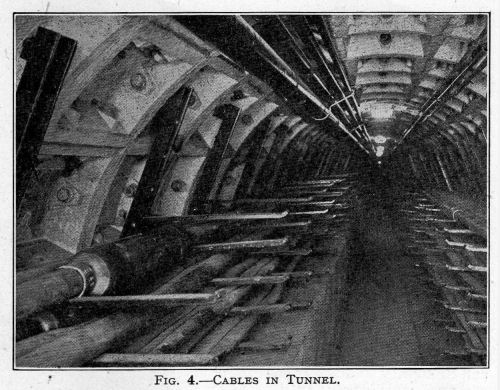
The construction of this tunnel, which is 7 ft. in diameter, and at a depth varying between 70 ft. and 100 ft. below the surface proceeded from three working shafts, one of which was retained as the leading-in point for the cables. A lift of sufficient capacity to take full size cable drums was installed in this shaft. Owing to the need for conserving iron during the critical period of the war, the greater part of the tunnel was lined with reinforced concrete segments instead of the customary cast iron. Plant was installed for the ventilating, draining and lighting of the tunnel. At one point an enlarged offset was constructed to accommodate loading pots. Among the arrangements for cabling was the provision of specially designed roller skates, which were attached to the cables to facilitate their movement to the appropriate section of the tunnel. A total of 60 cables with an aggregate mileage of 62 was installed in the tunnel, in which about 150 cables can ultimately be accommodated. A typical view of the tunnel showing the cables in position is given in Fig. 4.
SAFEGUARDING DEFENCE COMMUNICATIONS
Protection for defence communications was in general more elaborate and certain in its function than that provided for public communications, owing to the fundamental importance of maintaining the continuity of their service. In London this objective was finally achieved by putting the plant deep underground, or in exceptionally strong reinforced concrete structures having walls several feet in thickness. The most notable and comprehensive scheme of this character was the tunnel system constructed for the Service Departments.
Deep-level Protection.
This tunnel system is a comprehensive scheme of deep-level protection in the vulnerable central area for equipment and cables, carrying vital defence communications from the buildings of the Service Departments to other parts of the country. Associated with these specially constructed tunnels are the public and P.O. tube railways.
The ultimate scheme represents the accretion of five principal component schemes which were proceeded with at various times during the war. The initial scheme, commenced in December, was a tunnel 12 ft. in diameter and at a depth of about 100 ft., which, intended at the time solely for cable protection, is connected by short lateral tunnels of 5 ft. diameter to the Service Departments and Federal exchange. The latter is a protected exchange in sub-ground accommodation and was provided at the outbreak of the war to give an uninterrupted service for the principal officers in Government Departments.
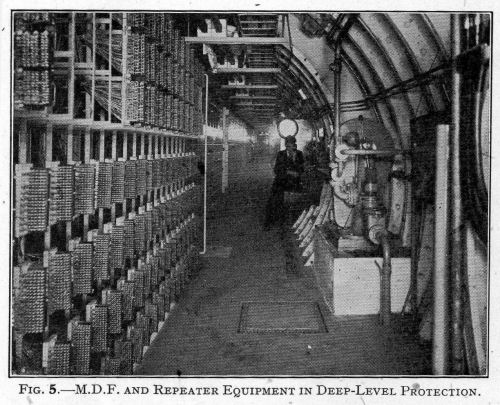
Access to the main tunnel for Post Office personnel is provided by an automatic lift and emergency staircase in a shaft at an exchange, which is connected to the main tunnel by an 8 ft diameter lateral tunnel. The cables from the buildings of the Service Departments. after being taken through 12-in steel bore tubes connected to the smaller lateral tunnels, are terminated on the M.D.F. in the main tunnel A portion of this M.D.F. can be discerned in Fig. 5.
It was obvious that the main tunnel would afford absolute security for telephone and telegraph equipment, the first installation of which was accordingly proceeded with and completed in the summer of 1941 to meet the increasing requirements for defence communications. This equipment, which has been added to from time to time, and now provides for about 4,000 working circuits, includes among the many constituent items, 71 18-channel V.F. systems, 26 canner systems, 13 coaxial cable terminals and 864 audio amplifiers A small portion of this equipment may be seen in Fig 6.

During 1941-42 major extensions of the tunnel, which more than doubled its length, were carried out, affording underground access between various Service Departments and accommodating a teleprinter switched centre. In all, a, total of 1 mile 740 yards of tunnel has been constructed under the various schemes associated with the tunnel system and six shafts with passenger lifts provided The tunnel system is connected via the tube railways to the Citadel building.
These specially constructed tunnels and the public and P.O tube railways have been extensively used to give deep-level protection to cables carrying vital communications. A total of 72 miles of cable has been laid in P.O. tunnels, 116 miles in public tube railways and 20 miles in the P.O. railway
“Citadel” Protection.
The tunnel system and its connection with the tube railways is an outstanding example of absolute protection for both telecommunication equipment and cables, but there were many other schemes during the war where circumstances only warranted, or made practicable, a lesser degree of physical protection. The Service Departments had many subsidiary installations for operational control, which, situated in areas subject to desultory bombing, accommodated very important equipment As this equipment could not be replaced with sufficient speed without serious interruption to the operational control, it was essential to provide very substantial protection for the installations. The associated line plant, although equally important could be more readily restored in the event of damage, and, moreover, the resulting interruption could be minimized by the provision of alternative routing. The physical protection for such installations usually took the form of a massive reinforced concrete structure, either wholly or partly below ground, with wails and roof several feet in thickness and the interior subdivided to limit blast effects from direct hits which might penetrate the structure.
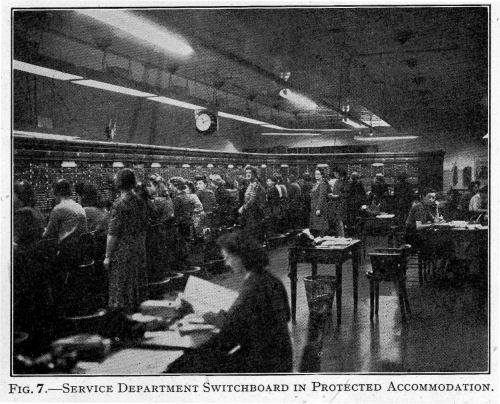
In the London Telecommunications Region there were nearly a dozen such structures, many accommodating a considerable amount of telephone and telegraph equipment. Fig. 7 shows a view of the switchboard installed in one of these Citadels. In addition, the installation included telegraph equipment for 123 teleprinters and other equipment for the remote control of radio transmitters. Steel pipes for leading in the cables at alternative points were laid during the construction of the Citadels.
Supplementary Security for Line Plant
In London the tube railways were used extensively to give deep-level protection for a few miles for the cables radiating from the central equipment. Beyond the emergent points from the tube railways, however, the cable routes were as vulnerable as any other underground plant at shallow depth, and with the persistent and widely dispersed bombing in 1940-41, the incidence of damage to these routes was sufficiently serious to require special measures to mitigate the effects of the interruptions.
The scheme adopted entailed the linking up, by circumferential cables, of the radial cable routes in the tube railways at a number of selected interception centres located not far from the emergent points. Included in the scheme were many of the surface trunk cables, which were intercepted at exchanges adjoining the main routes. At several places where the circumferential and radial routes intersected, and exchanges were not conveniently situated to intercept them, substantial pill-box structures, in which an interception frame was installed, were constructed. Interruption by bomb damage to any of the radial cable routes could thus be readily restored by suitable re-routing of the circuits over the circumferential cables at the interception centres.
The London scheme, started in the late autumn of 1940 and completed during the following year, involved the laying of 250 miles of loaded cable of various sizes An interesting feature in the cabling work was the completion of the circumferential cable system across the Thames by using the 12 ft. diameter pilot tunnel at Dartford, which had been constructed before the war in preparation for building the main vehicular tunnel.
The inclusion of the surface trunk cables in the scheme enabled not only defence circuits to be rerouted, but also important trunk circuits which had been interrupted by bomb damage to the radial routes, a facility which exemplified the duality of purpose of the Post Office telecommunication network in the national prosecution of the war.



Film 4 used it as a set for a horror movie!
Theres another tube line which didnt get electrified in the 30s, with stations at downing street, buckingham palace.
Under the MoD building is the wine cellar of Henry V111 whitehall palace. see time team special.
more here-
subbrit.org.uk
I am a member of SubBrit – and I can assure you that there IS NOT a tube station at Buckingham Palace or Downing St.
Those are some of the myths of the secret tunnels under London that really should be squashed by now, but they keep cropping up.
There is indeed a decent sized tunnel under Buckingham Palace though – it’s a sewer.
I have recently visited the Churchill War Rooms in London and was intrigued by the claims that a staircase led to number 10. It must have been a very long staircase as the CWR are under the Treasury, some hundreds of yards from Downing street. The only explanation I can come up with is that No10 “decamped” to the buildings above the CWR for the during of the war but that seems improbable. I also understood that the CWR moved from its present location to a more secure location under the Citadel at the of Old Admiralty Building.
When you say “hundreds of yards”, it is more like about 30 yards – and it is fairly well known that there are basement facilities that link up most of the buildings in Whitehall, so walking between Downing St and the Treasury building would take a minute or two at most.
I have worked in the tunnels under the treasury and can assure you there’s more than a couple hundred yards under there let alone 30 yards! It’s like a maze under there. And the sercuity to get in took half hour 45 mins!
I am referring to the distance between the two buildings.
Obviously, there will be plenty of corridors etc going in all directions, but between the two specific buildings is most certainly not “hundreds of yards”.
I used to work for Telecom/Post office in 1956 and I can assure you that their is a tunnel which was primarily for the transatlantic repeater stations beneath Whitehall telephone exchange. Due to the four minute warning time for a Russian Missile to get to England/London the tunnels were being refurbished with bunk rooms and canteen/toilet facilities and a self contained and sealed (if necessary) ventilation system that could maintain the air quality for nearly a year) in case of atomic attack. On a number of occasions I walked from the Whitehall exchange end where a vertical lift tunnel allowed access (after security checks) to the deep tunnel facility. On two occasions I came up in the base of the treasury where a sign was indicative that one should walk on the right side only due to the possibility subsidence. Of course there was access here to other surrounding buildings. And to Parliament square and possibly somewhere near Victoria Station thouigh I never got that far. At another end it came up in the Faraday Exchange not far from Black friars. The white hall exchange is very close to Trafalgar square down an alleyway on the right near where whitehall joins trafalgar square ring road.By a number 12 and 36 bus stop outside a pub.. There was also talk of a tunnel leading to the sentinel Building (solid Concrete almost) adjacent to Admiralty Arch where all the chiefs of staff used to discuss tactics. Although I have been in Australia now for forty years this is a clear recollection of my normal working days down the Pit as we used to call it. Further we were never allowed to take pictures down there and cameras were not easy to hide in those days. P.S. Did you know that Parliament Houses are haunted. When the place was bombed it was felt that seeing the seat of power damaged could demoralise the country. So it was a priority Job and due to the shortage of metal wooden scaffolds poles were used.
Five bricklayers Got killed and their Ghosts have been seen by many including me..
Dennis
Hi
Just fell cross your web page. If you ever go to Knightsbridge barracks which just happens to be full of guards Para’s and SAS. The accommodation tower is interesting. I was visiting my daughter who lived on the 22nd floor. On entering the building at ground level. The lift said level 5???? So what was 50 ft below me. Nothing on 4, Stables on 3 on 2-1 the doors wouldn’t open without a pass key
another rumour-
Have you any evidence of a connection between the jubilee extension line and the MPs offices basement?
I have worked in the tunnels under the treasury and can assure you there’s more than a couple hundred yards under there let alone 30 yards! It’s like a maze under there. And the sercuity to get in took half hour 45 mins!
I heard many years ago of a secret road tunnel between Windsor castle and Heathrow airport from a police officer who once served at Heathrow. Anyone know if this is true?
Well back in the early 1980s I worked for Greenham Concrete a subsidiary of Taylor Woodrow at a gravel pit at Stanwell Moor. I well remember meeting an old Irish fellow on the site who would mysteriously turn up on occaision and once told me that he was a ganger for the construction of said tunnel linking Windsor Castle to Heathrow Airport. The site I worked on was a concrete dispatching plant and would have been right in the middle of a possible route between the two landmarks. He also told me that he and his gang of men worked in weekly shifts and would go down and stay on site until the next bunch of fellows turned up and relieved them!
Nope – not even close to true.
“Five Days that Changed Britain” which was on BBC Two yesterday provided a useful confirmation of the presence of the tunnels under Whitehall. Peter Mandelson described how he and Gordon Brown used the tunnels to travel from Downing Street to meetings with Nick Clegg at the House of Commons after the general election.
Also, slightly earlier in the programme it says how David Cameron arrived at a rear entrance to Conservative HQ (Millbank Tower) then disappeared with the media not spotting how he left to head to a meeting at Admiralty House on Whitehall with Clegg. You have to wonder whether Cameron made use of the tunnel system to travel from Millbank Tower to Admiralty House discretely. Could it be that Millbank Tower is somehow connected to the Whitehall tunnel system or there is some way to get through to MI5 HQ (Thames House) next door which may then be connected underground to the tunnels under Whitehall?
I’m an ex Lifeguards regiment trooper and did a lot of guard duties at Horse guards back in the 1970’s . Going down into the basement/showers area near the guard room you could see where the tunnel ran past (Door and windows blocked up) though it was obviously pretty dark and not a little spooky!!
It is indeed called Whitehall ‘Q’ Access to the tunnel is in Whitehall exch. at Craig’s Court. I worked down there many times as a Telecom employee and goes up to Charing X as well as down to Westminster. There are many access points always tucked away somewhere like a wall in Horse Guards Pde etc and Trafalgar Square.They bored into the tunnel down by the Broad Sanctuary and flooded the place which I had to help fix up. Some tunnels were smaller diameter but also some big ones as well. Runs down to the embankment where the tourists boats park left of the brifge and others go for miles. Great to see though and hear when the underground runs above you.
Also worked in MOD, Buckingham Palace and Westminster to name a few and one of the best jobs I have ever had. Loved the cable joints down there as extra long due to fact they had to be same thickness almost as the cable as they ran along the spaced racking.
I was working there in 1956-8 as a rechnician 2A, till I joined the Army.
What period were you there? Do you remember the operators (girls) and the old test desk.
WE rarely started work till we had breakfast in the canteen as the foreman wouldn’t let us.Happy days. Started at two pounds ten shillings per week until I passed the technician point then it shot up to 11 pounds per week, for a period I was rich. Went down the tunnels many times almost blacked out the place once when a metal lamp standard I was using fell against the overhead BUS Bars and disintegrated.
Ian.
I’m making enquires into the Alleged Tunnels that run from St Ermins hotel in Westminster, to the Palace of westminster.. as legend has it that the hotel was used during WW2 as a base for the Allied forces command centre, and for SOE? and both groups are to have used the tunnels under the hotel as a way of escape in event of emergency.
Also after the war, the Spy Guy Burgess, was believed to have used the same tunnels to avoid surveilance teams following him at the time.
any help would be greatly appreciated.
I briefly worked at the St Ermins hotel as a night receptionist and indeed at the top of the flight of stairs from main reception is a small door. It leads into a passageway that leads to an underground tunnel/station extension – it was too dangerous (and way too creepy) to proceed further than I did (unapproved as it was) but it seemed to look in good nick and extensive – wish I had gone in further
in one of the pierce brosnon bond films there is a scene where bond opens a door in what appears to be the plinth of a statue and descends into a tunnel though the rest of the scene is obviously on a sound stage at pinewood its the scene where john cleese(the new q) shows bond his new bmw which has an invisibility facility on it
Just a door way in the side of the old GLC building, it goes no where special.
That’s Hollywood for you
Thank you Ian
another great article
Nick
Anyone out there who used to work in the teleprinter room at the Citadel, off Whitehall around 1948/49? I’d be pleased to hear from you with any memories and/or contacts of former Royal Signals people who may still be around.
I worked in the tp room under the citadel (whitehall w/t) in 1961/2
I used to work in Faraday building in the 70’s .It was an International phone exchange ,huge .On one side 5 floors on the other 7,as it was on a hill
we were told then Churchill had his phone exchange there .If you went down in the lifts the open sections ran forever .We were also told they had built an underground hospital there on the 3/4 level below.
Interesting building .Still there but I dont know what it is used for now
Mike, half of Faraday is demolished and the land released forms a new hotel complex. The remaining blocks form an HQ for BT Openreach, comprising offices, but still houses the old cable chamber and equipment. it’s still an interesting place to work in, but there’s not much history still evident as successive modernisations remove things.
Faraday north block went a couple years ago,they managed to knock it down,there is now a Japanese owned luxury hotel on the site,original Carter Lane marble entrance has been preserved on the Addle hill side,south block is still there still BT
During 1986-87, I worked as a barnan in a pub next to the old Faraday British Telecom exchange–The Bell Pub in Addle Hill EC4. All of my customers were BT telepkone operators and engineers. They told me stories of secret war-time bunkers under Faraday that Churchill used, and stories of tunnels used during WW II. I enjoyed hearing the stories, but don’t know if they’re true. As it happens, I’ll be in London August 3 and 4, 2014, and I would love to have a pint with any of my old customers–please do e-mail me at: jimbergmann@hotmail.com. I am Jim, the American barman–under Governors Phil Harding, and Bob & Pat Hughes.
When I worked at the Regent Palace Hotel during the 1970’s a manager took some of the staff on a tour of the extensive basement level, where we were shown a series of tunnels that went close to the tube station. After some time and several torch batteries we ended up in the basement of a club near Trafalgar Square. We were told that this was one of several escape routes that linked the hotel to other places within the West End and to Whitehall. No idea if this is true, but apparently the government requisitioned the Regent Palace during the First World War, and these tunnels were used, during the Blitz to get around central London in relative safety. Don’t know how much of the system would be still there after so much of the RPH was demolished.
My father worked at Q Whitehall. He was a GPO Engineer. My father took me down into the tunnel back in early 1950’s. I slept down there over night so we could both go and see my mum the next day. She had had a serious operation and was convalescing somewhere down on the south coast. So it does exist. But I wont tell you how we went down or where the entrance is.
We know it exists — you’ve just read an entire article about its construction.
Micheal,
If your father was George Boulton I knew him in the 60’s when I worked at Q Whitehall.
i recently found tunnels under whitehall which were not tube tunnels but looked like they were built victorian times most of the entrances to other tunnels had been bricked up but they led out right under whitehall they were like walkways with lighting and i also found a old water tank in one of them
does anybody know what they were used for
See My reply above a few other comments
Dennis
I was based as an Engineer at 107-111 Houndsditch and was told tunnels from there stretched to Faraday and Holborn. Before being used as a Telephone Exchange, Houndsditch was an army HQ. According to a Post Office Magazine, it was haunted by the ghost of a Captain that had shot himself. Holborn Exchange was a giant nuclear shelter. Excavations for that began in 1951 when concerns were growing about Russia. A tunnel also connects Faraday to Covent Garden Exchange.
I used to have a book called ‘London Under London’ by Richard Trench & Ellis Hillman, which explained in great detail the subterranean world of London. Not sure if it’s still in print, but worth a look by anybody interested in the subject.
I worked in Whitehall about 15 yrs ago and the tunnels under the Treasury are all still there and intact if a little dark and scary. I even found the old firing range with shells and score cards down there. Fantastic place.
All this nonsense about tube trains and stations for the royal family under Buckingham Palace obscures the probable real truth that there are still plenty of PO/BT tunnels yet to be discovered. For me, I can see some sort of extension from the Admiralty Citadel bunker beneath HorseGuards along the Mall to Buckingham Palace. Duncan Campbell only got as far as a Manhole Cover outside the ICA and the famous extractor fan in the gents so we know not what goes beyond this point. Or, there could be a small short distance tunnel leading from Buckingham Palace to Wellington Barracks over the road.
My other theory is another Po/BT tunnel running west of Parliament Square and the QEII Centre, where there are access points to the Whitehall tunnel system
( Just look outside on the front lawn ) Beneath this building are telephone exchanges and “other installations which we cannot move” according to a Department of the Environment doc I found on the internet dated 1980. I feel there could be another tunnel west of here along the Victoria Street alignment connecting the various government offices along this route, south of St James Park/Birdcage Walk.
Goes to Marsham St. What was North and South Rotundas.Built in the holes from two gas holders.Now demolished.See Subbrit.co.uk for info.
Hi Ian, great article. I recently came across an memo in the National Archives about the extension of the Whitehall tunnel to the cabinet war rooms during WW2. Don’t know if you’ve seen it? It’s in CAB 80/30 and discusses plant, machinery, lifts and ventilation.
There’s something still under the Home Office at Marsham Street; it covers the whole site and the top of it is something like 30 feet below street level. I was working opposite when the work was being done. Since my desk was against the window, I had a grandstand view every day of the work being done when they took down Marsham Towers and built the Home Office building.
They demolished the old rotundas, but they only took off those and the next level down. The way the work was done you could see that there was at least one level down beyond that; according to security, there’s something like four of five more levels down, and a tunnel somewhere. Work could be seen going on in the intact level immediately below.
Anyway, having taken off the top levels, and done whatever work was needed on the lower levels, they laid a concrete pad across the entire site. This took the weight of the subsequent building. The pad was continuous *except* for one bit. That became a lift shaft for a lift that serves the Ministerial floor. The lift shaft went up first, along with the shafts for the other lifts; that’s normal. I did note however that the lift shaft down to the underground facility was smaller than the main lifts. It’s the size of a lift for staff only, rather than one expected to accomodate trolleys carrying goods, or funrniture being moved around.
It is a lift only – there are no stairs accompanying it. There is no other access on the Home Office site to whatever is under there; the very thick concrete pad sealed it off entirely, except for that single lift access point. Since it would make little sense for emergency facilities to be totally reliant on a single, electrically operated lift for entrance and exit, one would presume that there must be access elsewhere. That access however is not on the Home Office site. Incidentally, whatever is down there is referred to as ‘the bomb shelter’ by Home Office staff, and the lift is reserved for Ministers only.
Interestingly, Marsham Towers did not rest on the soil. There was a six foot gap between the floor of the basement and the soil covering the underground structure, with the building above supported by columns. I went on an explore one day, years ago, when I worked there. There was a metal hatch and stairs going down under the basement. This allowed access to the level under the basement. I, of course, had to take a peek. 🙂
Really interesting Kevin.
According to the map I have seen when Duncan Campbell made his expose of the PO tunnels in 1980 in the New Statesman, one of the tunnels runs south from the QEII centre ( where there is another underground facility ) to the area of Marsham Street where the Home Office building now sits. So that would tie in with your ref to a tunnel elsewhere.
Also, I read somewhere there is an odd looking building on Monk Street on the west side of the site which is another street level access to the underground system. One can see it on Street View.
Friend of mine is a crane engineer.He worked on the cranes on the QE11 site.Very interesting deep sub-basements.Walking access to PoW.Lots of heavey plant down there.Lots of room.
This is really interesting thanks for all the comments and info. I used to visit the old Marsham Street building in the 80s and there were several basements. 1 level was used by different groups and societies and was a long corridor with low ceilings and rooms either side. The next level down was also used but can’t remember what for. I did an explore down and there were at least 2 other levels down but no lights and it spooked me out. Would have loved to taken a torch and had a good luck around. In those days you could have a wander round if you had access to the building.Changed times
I served in the Household Cavalry in London between 1972 and 1977 in The Lifeguards regiment. Often did sentry duty there mounted and dismounted.
The is a basement under Horseguards with showers and locker room and a big boarded up door on side nearest the parade ground. The was a small broken window in the door which was jet black. Obviously no light it wasn’t possible to see anything in there at all but we were told the was a passageway wide enough to drive coach and horses through….
There are two distinct deep level systems under Whitehall. QWhitehall is GPO/BT operated and is accessed from Whitehall Exchange in Craig’s Court. There is a connecting door that joins it to the Admiralty. The other network has the prefix ‘Y’. YWhitehall is purely Government operated. In fact there are several ‘Y’ units around London and were interconnected with the BT junction network. The BT deep level network was very extensive. The most westerly point was Keybridge House in Lambeth, the most southerly point was Colombo House (Rampart) in Waterloo and it extended out to the east via Trunks Kingsway which was in a tunnel that ran parallel to the Piccadilly line branch to Aldworth. In fact new equipment racks were delivered to the exchange on a flat car from the underground – there was a door between the two tunnels! My father spent several years working in Whitehall for the GPO and some of his duties required regular visits to the deep level.
I worked at Keybrige when it was a building site and when it was handed over to the GPO/BT, it was not on a deep level system. The only tunnel was a very short one, from a man hole just down the road. When this tunnel was being built, a worker was nearly killed when he hit an underground spring.
I remember entering Q Whitehall in the early 80’s, there was a map (drawn) on the wall down in the tunnels; wish I had copied it then; but I do remember two entrances on Whitehall (Craig’s Court as mentioned and one by the Foreign Office). But there were routes to Horseferry Road so that was most likely the connection to Marsham street (which had an extensive basement with the Civil Service sports club having gyms, and other facilities down there). Colombo house also had an extensive underground level; though I never knew it was part of the system. Finally in Westminster exchange there are several levels of basement; one contained bunk beds and stored ration boxes; there was a locked ‘War Room’ I never got in, but seem to remember the mention of tunnels under Victoria Street (with New Scotland Yard and other government buildings it made some sense). For Q Whitehall to join up with Keybridge and Colombo there would have to be routes under the Thames. Keybridge is now being developed, perhaps someone on the site might know more.
To throw into the mix – mention of Waterloo. Of course Century House was based at nearby Lambeth North (on the Bakerloo Line)
I worked from the old monarch exchange on subs apps mntc 1963/1965 in the-basement there was a locked steel door that led to other exchanges if I remember right you needed a special Pass and re sign the official secret act to enter.cables went from one telephone area to another via these tunnels so if an exchange got knocked out during the war there would still be some communication.the old exchange was still in wood street if you went in it was exactly like when it stopped being use looking round was eerie you could almost here the girls chatting it was half under ground if memory serves.i worked with a really nice bunch of blokes our A/EE was Ron bell best governor I ever had
My Mum was a GPO telephonist during WW2, and told me that she and her friend worked in Faraday and Citadel and they used to sleep underground in a bunker – 2 in a bed (head to toes), and if the air raid warning sounded they had to go through the tunnel to the embankment. Wouldn’t it have been safer to stay in the bunker? Where exactly did the tunnel come out?