
Amongst the fluffy bunnies and clucking chickens that can be found at the Mudchute city farm sits a now silent visitor – a World War Two era anti-aircraft gun.
The farm occupies a plot of land taken over the Home Front where they based four anti-aircraft guns (Ack Ack Gun) to attempt to shoot German planes out of the sky as they attacked the valuable docklands of East London.
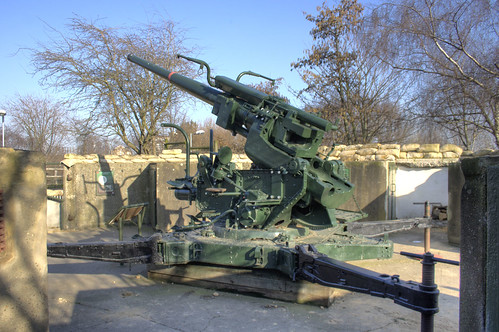
Last year, following a Heritage Lottery Fund grant, they were able to restore one of the guns and the surrounding concrete bunker — which had served a post-war function as somewhere to keep the large animals overnight.
The gun itself is one of the types most commonly used around London – and could fire 3.7 inch shells.
Of all the gun sites across London, this is also one of the more historic ones to restore. On the 8th September 1940, the nearby command post was destroyed by landlines being dropped from German planes, so the commander of the battery, Captain W.J.S. Fletcher RA went around the four gun sites and encouraged his young crews to carry on firing the guns manually.
He was awarded the Military Cross for his actions that night — the only one awarded for action on British soil, and the entire unit was commended for bravery.
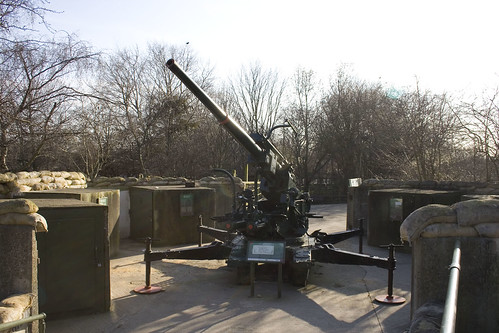
Stacked around the restored gun are the original concrete ammo storage boxes and some suitably decorative sandbags line the walls. A number of display boards also go into the history of the site.
Although the gun obviously cannot fire anymore, it still rotates, and when I visited parents seemed to delight in putting their kids on top to spin the handles, or occasionally join in themselves.
Yes, you can aim the gun at the Canary Wharf skyscrapers if you so wish.
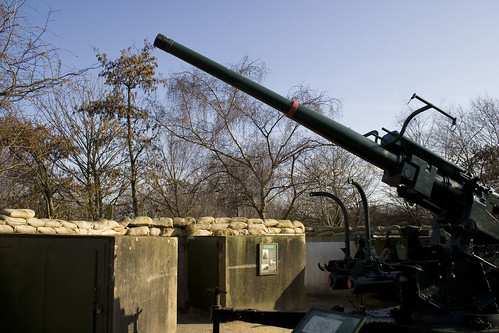
Oh, and concrete bunkers for the other three guns? Two remain, and are now the pigsty!
The farm commissioned this film about wartime life on the Isle of Dog.



Very interesting!
[“landlines” should presumably be “landmines”, and how many dogs on the isle?]
I found this while I was living nearby last year but didn’t realise it moved. Need to go back for a closer look now!
by an ex-wartime AA site commander.
At the start of the blitz Radar (then RDF) was in its infancy and fire control depended on being able to see the target (ie illuminated by searchlight). This was rare, so for the first few nights of the blitz fire was only sporadic and ineffective. People asked ‘What are the guns doing?’ and morale draopped. General Frederick Pile (AA commander) ordered fire which really amounted to “Point in the direction of the sound, and chuck as much scrap iron into the sky as you can” – hence the manual control of the gind when command post destroyed. And as rightly said,it forced the bombers to fly higher, deterred some, and the noise helped morale anormously.
The gun shown in action in the video (with the square shield) is a 4.5 equipment, similar to those originally on the Isle of Dogs site. They were not as stated. naval guns (the naval equivalent was the 4.7) but scaled-up version of the 3.7.) I do not know of any preserved example of the 4.5
Further to my blog above. The gun shown now being mounted as shown is of a type never deployed in any permanent concrete site. The 3.7 came in a number of marks. Mks I and III were mobile mountings and used by Field Armies and as a mobile reserve by AA Command. Once complete. concrete sites were armed with either 4.5 or Mk II (Sratic) 3.7s, The present gun was either Mk I or III. While the photos are not entirely clear, I am 98% certain it is a Mk III. If as the video.suggests they were later replaced with 3,7 , they would be”bastard’ Mk VI 3.7s – 4.5s lined down to fire a 3.7 shell using the heavier charge of the 4.5, giving longer range and greater velocity.
Talk of ‘hits’ is farcical. Firing to hit an aircraft would be the equivalent of try in hit a flying pigeon at 100 yards with a sniper rifle!. The shell was designed to burst as near as possible to the target and the resulting ‘splinters’ (weighing up to half a pound) would, it was hoped, damage the aircraft, the equivalent of a shot gun spread (The splinters fell to the ground and many were picked up as souvenirs: they could be red hot!). You can read the whole story in Gen Pile’s book ‘Ack-Ack’ long out of print, but your local library should be able to get a copy
Regarding Allan Wainwrights blog,I guess he was in 154 battery,52 Rest.I was in 155 by,stationed on the Gun Site at Chaldwell Heath, We started off there with four 4.5 guns in the latter part of 1939,and after several weeks,another four guns,also 4.5s were up and ready for action. These were manned by Right Troop who had been at Barking Park.as time went by,the guns were fired by remote control.
My Father Peter William Vickers, From Walmer Rd, London W10 and his mate Joe Kennedy of Lonsdale Rd W 11, Defended Docklands Surrey ( The Hogs Back) and round to Kent including Biggin Hill East. Dibden, Biggin Hill West, down to Plymouth and Totten and back to Biggin Hill, Grove Park.
Their unit was the 217th Hy. A.A. Battery R.A. Hampshire Carabiniers Yeomanry.
Between July 1939 till 7th September 1941 They defended London from 17 Firing sites. They then reformed their 1 & 4 section to become ‘A’ Troop. 14th November 1942 they disembarked in Bougie N, Africa fought using those big guns all the way to Tunis & Bizerta 21 September 1943 and in October 1943 Landed in Naples Italy. They arrived in Naples January 1945. My dad lost 2 mates from the troop, Bill Bishop from Kanning Town, and Fred Horne from Oxford. Dad was 5’61/5″ and weights 8 stone. imagine being that small and fighting 6 years on those guns. Even as an old ‘Gentleman’ he had muscles of steel. He died in St Charles Hospital W11 aged 73. RIP Dad. Son, Albert Charles Vickers, Andalucia, Spain. 2014
My late father, Bombardier EJ Nicholls, whose parents and sister lived in Cheshunt, and wife and children lived in Trowbridge, Wiltshire, served in an ack ack unit on the Isle of Dogs during the blitz. He was so proud of his service, and from time to time he would tell us something of his experiences. I have his memorabilia, which includes the RHA badge, with its rotating wheel (the genuine article sought after by collectors). He served in both World Wars, and in between, was demobilised at the end of the war. He died in 1973 in Trowbridge.