
After 16 months of preparation during the height of the blitz, a secret aircraft components factory was completed deep underground in North London in what were unfinished tunnels for the Central Line extension. The factory was completed in March 1942, so I have missed the anniversary, but no one else seemed to mark it either, so I am still going to write about it.
The factory was operated by the electronics manufacturer, Plessey and after their Ilford factory was bombed in late 1940, they persuaded the Air Ministry and London Transport to let them use the unfinished tunnels between Leytonstone and Gants Hill as a wartime factory. The conversion of the tunnels into a factory was completed in March 1942 at a cost of £500,000, giving Plessey 300,000 sq. ft. of factory space.
Parts of the factory was actually in use before March 1942 – but the conversion was staggered over time and completed 70 years ago last month. The sort of things being assembled in the factory included wiring sets for Halifax and Lancaster bombers, wireless equipment, field telephones, and Enigma Code-breaking “Bombes” for Bletchley Park. Up to 4,000 people – mainly women – worked in the tunnels for the four years that it was in use.
Workers worked long hours, beginning at 7.30am and often working overtime for no pay. The knowledge that they were doing their bit for the war effort was enough of a compensation for many people. It must have been a very odd environment for people who were more used to working in large well lit ventilated and lit factories to suddenly be plunged into a tunnel with no daylight, limited fresh air and no smoking. The toilets were presumably at the surface, with maybe emergency chemical toilets in the tunnels – which would mirror how some shelters were designed at the time.

Access into the factory was via the three unfinished tube stations at Wanstead, Redbridge and Gant’s Hill – and two more intermediate shafts were installed to let goods and deliveries to be taken down to the submerged factory. Although the stations at Wanstead and Gant’s Hill are quite deep, the one at Redbridge is in a valley and almost comes back up to the surface at that point. In order to pile up some additional protection from bombs, soil from the construction of the deep level shelters in central London was dumped around the station to build up the depth. As the valley was caused by the River Roding, a couple of watertight doors were also installed in the tunnels around there just in case a bomb did manage to hit the location.
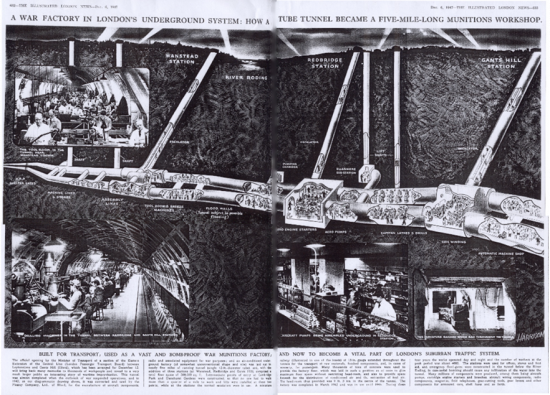
Although built in unfinished tube tunnels, it still had its own mini-railway to carry components along the factory – you can see the tracks in the photo above. The railway was supposed to be used just for goods deliveries, but apparently made for a useful service when VIPs visited the site.
It wasn’t just the tunnels though – the stations were used – as shown in this under conversion photo of the platforms at Redbridge station and also there were storage facilities at the surface.
After the war, the factory was removed and the tunnels converted back to their original purpose, an extension for the Central Line, and in 1947 finally opened as such. An article from the London Illustrated News, December 6th 1947 had some details about the factory – although the cut-away drawing massively exaggerated the depth at Redbridge station, which is just two flights of stairs – not a deep escalator.
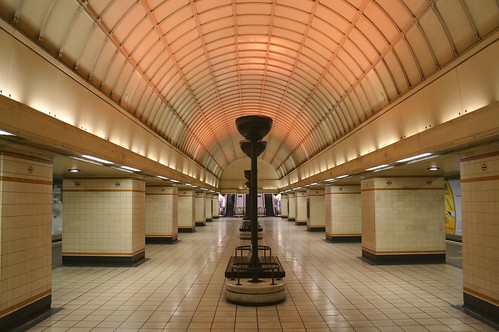
Today, the three stations are just ordinary tube stations without a single hint left of their wartime endeavours. Not even a plaque that I could see.
Although Gant’s Hill platform corridor is rightly famous, the surface building is a decaying slab in the middle of the roundabout.

Back tracking along the Central Line at surface level, if you know where and what to look for, there is a very distinctive brick tower stuck between two houses on the main road. This is today a ventilation shaft but was originally constructed as a lift tower mainly to carry goods in and out of the factory, but also offered a short cut to work for those living close to it.

As I was photographing it, one of the neighbours came over and asked me if I worked for London Underground and could I tell them that the front needs to be cleared up. I can see her point!
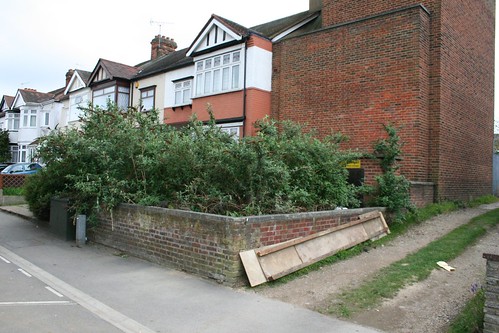
Those plants looked like Buddleja – which is generally considered to be a weed by railway companies as it has very invasive and hard to remove roots. If TfL were to clear it – maybe they could agree to let the neighbours use the space for pot plants? Topically, considering I am writing about wartime efforts – the plant is very swift at colonising rubble and was nicknamed ‘the bombsite plant‘ among people of the war-time generation.
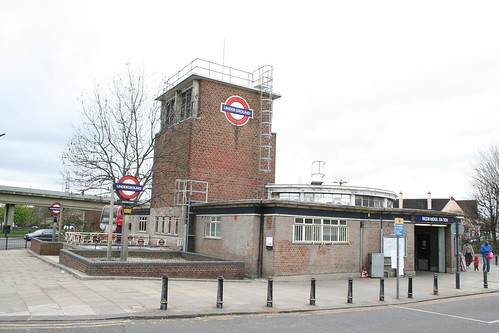
Further along the road is Redbridge station – the one with tracks closest to the surface and which was covered over in extra soil. I presume that had it not been used as a WW2 factory, it might have been an open-air station as it is today just two flights of stairs down to the platform.
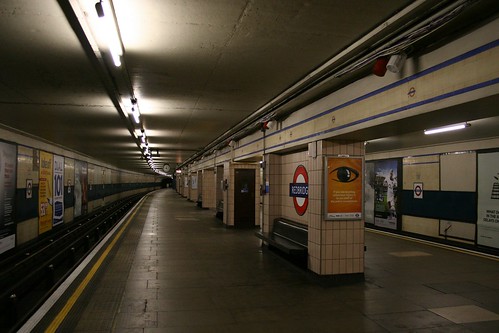
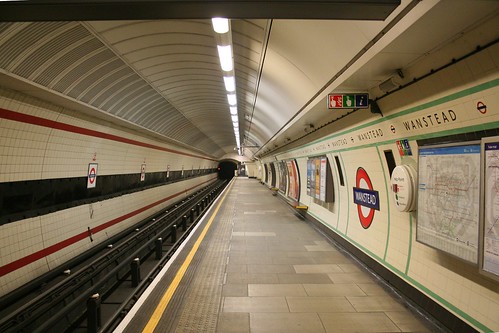
A quick trip on the train over to Wanstead station.

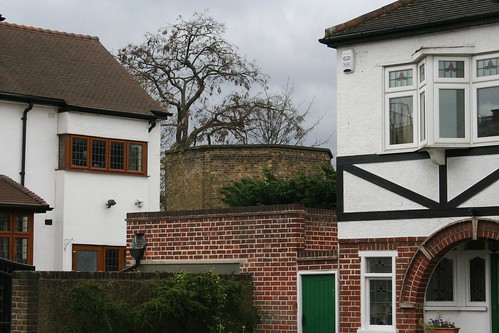
Now to find something which was only cursorily mentioned in the researches – another ventilation shaft. I knew that two shafts were constructed and that one of them was on Cambridge Park, which is a road between two stations. Some searching on Google satellite view suggested a target, and checking with the Land Registry confirmed that this plot of land is indeed owned by London Underground – along with various sub-surface features.
The octagonal brick tower peering out between two houses.
And visible from a secure and unmarked gate. The sign on the door by the tower warned of a deep shaft within.
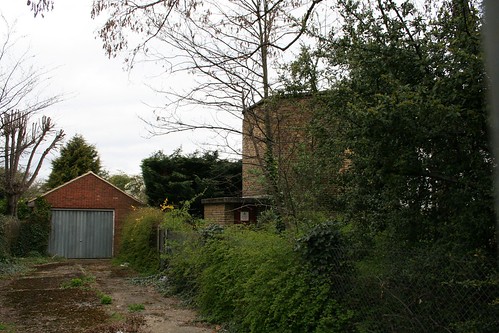
That’s all that’s visible today. This is a pity as I think it would be nice to remember the unusual and vital use this section of the Central Line was put to during the war.



Another great read Ian, always interesting articles 🙂
All the concrete reinforcement caused some issues during some major delays during roadworks a few years ago. Seems someone forgot about the tunnel’s past.
Article from local paper
http://preview.tinyurl.com/threcorder-co-uk
Redbridge was always intended to be a covered station. The station building was designed by renowned Tube architect, Charles Holden. The platform area itself was built as cut and cover. At the far end of the station carpark is another small building which I was told by some engineers working there when they did the signalling upgrading led to a sort of complex under the carpark. There is also a further tower which is now in the middle of the roundabout.
in the round corridor of gants hill station are sealed metal like doors painted white ,behind them are the secret war factories making spare engine parts for vickers during the war,today people dont see them as a doorway to tunnels under gants hill,one of them is just five feet above the tube roof,another is a 35ft shaft to the sewer in case of severe bombing escaping down the sewer leading to ilford high rd ,some of the books written in the sixties quoted a house which was the exit out of the tunnels,a normal house in the street,700 yards from the station,its quite hard to find now,but can be found …happy trails ian.
A really interesting read Ian. I love anything to do with the war and articles like this keeps my interest fuelled.
Absolutely fascinating article…and follow-on comments – thank you ALL so much!
I grew up around Gant’s Hill & spent many a happy hour playing / cycling around the many station entrances (incl. SevenWays Parade?) but not even my parents were aware of the underground factory…and my Dad was an Air Raid Warden for some of the war.
Thanks also to my son (an avid historical architecture buff) who saw your article & passed it on to me – we are all down on the South Coast know…but still have strong links (Essex Cricket Club + the remaining Leyton Orient fan).
I looked up the Wanstead Station page to try to find the date that it was opened. I am writing my Life Story & I used the station on the first day it was opened to return to my barracks in 1947 when doing my National Service. In 1937 my parents, sister and I lived at 71 Cambridge Park. London Transport made a compulsory purchase of the property to build their air shaft. We moved to Nutter Lane where another air shaft was built about 100 yards away in the central reservation of Easter Avenue. I can well remember the stories of the “secret” war factory of Plesseys in the underground tunnel. Thought you might like my first hand knowledge of this. P.S. I now live in Cornwall/
Bernard, I’m 5 years late in a reply, but if you see this please let me know. My family owned Pembroke Lodge at 73 Cambridge Park a few years before you time, and I’d love to know what happened to it. Was it also purchased in 1937 and demolished?
There is a commerative plaque at Wanstead station – in the hall between the platforms where the escalator comes down.
My Mum, Olive, worked down the tunnel during the war. She will be 90 this year.Some years ago she wrote this about her experiece there:
“Mum, by that time, had got herself a job at Plessey aircraft factory, working in the Underground tunnel in Wanstead. She said “Why don’t you come to Plessey ?”. I didn’t like the idea of machine work, so I went to Ley Street, Ilford and had an interview to do inspection work. So I started going to Wanstead with Mum – and that lasted the duration of the war.
When we got to Wanstead Station, hoards of people were converging to the entrance. You had to show your pass to the security man. There were two security men. Then in you go, down the escalator – wave to Mr Fossey – he worked in the drawing office on the left hand side. They all wore green eye-shades. Then we clocked in. It was fantastic – we walked past machines three yards long on the left hand side and the other side had a little railway line for taking materials up and down and Nobby Clark – the Big Boss of Plessey- would come riding through. It was a hive of activity. After walking for ten minutes, I was left at a green wire mesh cage which was the inspection office. I was introduced and then trotted round to the drills. To get there you had to duck down and walk through a little tunnel to get onto the other platform (the ‘up line’ and the ‘down line’). I was told what to do. They gave me a rubber stamp, a metal stamp and a rejection pad. They told me all about dockets and drawings. I had to buy my own rule and pencils.
The air-conditioning and lighting was superb. As soon as I got the idea, I had to go with another person up top to get two white coats. Round about 10a.m. a bell went off and we all got a ten minute break – you grabbed a wooden box and sat with your friends. A man who was disabled came limping down the tunnel with two white enamel pails and a ladle – and that was tea. A woman behind him had a trolley piled high with the most delicious cheese rolls I’ve ever had, and yellow-peril cakes. They looked after the forces and munitions workers when it came to food.
I started checking seven machines and got on very well. The setter was a nice chap. His name was Frankel – a Jew, I think.
There were rats down there. The first two rats I saw I thought were kittens. One was ginger, the other one was black. Once I had a rat run over my foot ! I started leaping about, and that caused a laugh.
I progressed to every line in that tunnel; mills, tapping, baleys, Capstans. I got efficiency money, but in those days we didn’t get paid well, so I went on permanent night work.
When I worked in the tunnel, one night a chap called Bob Olsen came in and he looked terrible. He was a charge-hand. He was about thirty-five to forty, quite old to me being only twenty. His face was ashen and he was just like a zombie. His house and all his family were bombed outright. He kept working. There was nothing else to do”
My mother worked there during the war too! She is now 91 years old. She was at Gants Hill and worked a tapping machine.
John Saville’s website has lots of photos of Plessey’s and is really worth a look.
And the BBC are currently making another programme in the ‘Britain’s Flying
Past’ strand, presented by John Sergeant. They will be
focussing on the Lancaster Bomber and the stories of those who
associated with it. As part of the programme, they will be exploring the Plessey use
of the underground tunnels for manufacture of small parts for the
Lancaster. I believe it is due to be screened in September 2014 if anyone is interested.
Hi Ian, very interesting stuff. My father who is 89 this year used to work for Plessey in the tunnel and also in a house on the Eastern Avenue which was used as a lab. In the back garden of the house was one of the access shafts, possibly the one in your photos. He went to work one day to find the house had been bombed. He also has a great story of going to the door and being confronted by a brush salesman who asked “Is your mum in son?”. he said no but the chap wouldn’t take no for an answer. Eventually he went. It struck my father that the chap didn’t think it a little odd that a boy, wearing a lab coat opened the door during the day, was not a school or work? He said many people would walk through the house and out the back into the tunnel every day and nobody said a thing. Also, in the summer, the girls used to come up for lunch and a smoke and sit on the roundabouts at Gants Hill and Redbridge stations and nobody thought it was unusual or asked where they had come from. When there was a raid on, he would walk down the unused, dark parts of the track from Wanstead, under the river Roding to get to work and avoid the bombs. I’ll ask him to check out your site and give his own account.
I have been looking for this information for so long. My mother worked under Wanstead station on nights. I have seen nothing since the East London Advertiser did a review many years ago. Thank you so much
Also as I live nearby this is a interesting read.
Re old LU ventilation shafts; Hello Ian.
I own a really fascinating old building which I call “the tower” at 9 Whitechurch Passage E1 7QU, which is a four story Victorian building about 16 ft square, right next to Aldgate East.
It was acquired by London & Metropolitan about 1868, floors stripped out, used I think for building the line, converted to a massive vent with extractor fans at top and bottom, then after electrification new floors put in and acquired by my great granddad about 1908 who used it as a woollens warehouse.
You can still see the steam engine smoke soot encrusting the inner walls in a couple of places where the surface plaster has been removed.
Would you like to see it?
Contact me by email or phone me on 07877254247
Suberb information. I saw some programme on Discovery channel about this Harry Harris. A cabbie has a show. He mentioned the shaft between the two houses but also another shaft in the middle of Redbridge roundabout. Is this right as you have not mentioned it. The Cambridge Park is something i was not aware of. Want to go to explore this. It is a shame English Heritish can not open up the shaft and see if anything is still there. It be nice to have a Programme about it then too.
Thank you. I love local history.
My mother now aged 91 also worked in the tunnels at Gants Hill and her twin sister worked at Redbridge. Mum remembers not seeing the sun for months at a time; taking an early morning bus from East Ham and going home until after dark.
On one occasion she caught her hair in a machine and a large tuft was ripped out of her scalp. When she got home that night her sister asked if she had heard about the daft ****** whose hair got caught in a machine, at Gants Hill. Then mum took of her hat and showed her who the “daft ******” was.
Wow what an amazing article and peoples comments. I’ve often been to or through these stations in my youth. But I had no idea of the history. Brilliant
I’ve just come across Ian’s excellent article. One response refers to the photos on my website. You may be interested to see them from http://www.jrsaville.co.uk/plessey_factory.htm
I am in touch with a couple of people who worked in the Plessey Underground factory. If anybody also has contact with other people who worked there, and are still with us, I’d love to know. My email address is on my website.
My Dad, Teddy Earp a joinery expert used to run a factory in the East End which made the wooden formers for Hurricane aircraft. He died a long time ago and I’d love to know where this was? Seem to recal it might have been in Poplar. He was bombed out of his lodgings 17 times.
East London Ian, East London. The postcodes here are E10 and IG for Ilford. North London is some distance away.
The book London’s Secret Tubes (easy to find on Amazon) has an entire chapter devoted to the Plessey factory, with period photos taken both above and below ground. This also deals with the heavy engineering works required to convert the factory back into a usable railway. The book also covers other underground factories, bunkers, command centres, trunk telephone exchanges and suchlike built below London during WW2 and the Cold War era.
My dad Bill Neville did his apprenticeship in the tunnels in 1945 and is now 88. He describes the efficiency of the design.
HI, I still have my late Farthers Agreement with Pleesey from 1940 employed as a Jig and tool desgner in the Drawing office at Ilford at a salary of £4.5.0. per week, This incresed to £390 per annumin in August 1945, At the time B.G. Clark was a director Never said much on his work there, At the time he lived in leytonstone E11, and fire watched in Redbridge after work
Dear Ian, I am a student of wanstead high school and believe there are tunnels running through the bottom of our school that were active during the blitz there is much evidence to support this and i was wondering if you could find out more about the subject as the head master did not give any useful information
I’ve always take a great interest in the background of the ‘War in the tunnels’ and have seen numerous photos of the times of these historic workers there and amazing pictures in all but what I like to know is the tunnels had a entrance or part of a tunnel from the ‘Plessey’s’ building which is sadly gone and now a plot for the houses which has all been built but wondered if the builders had filled the tunnel/entrance to them or have they just sealed it over leaving the tunnel in the below depths? I just cannot work out from the Newbury Park station that it IS quite a way from Plessey’s building and the Gants Hill one so was there a extra tunnel that now does not get used from the Plessey’s site? There was a programme ‘Secrets of the Underground’ & DID show some sights on some other areas & was interesting plus a station that’s still there but never opened to the public at all. Tunnels are sealed & not used for the trains in some places but the above of Plessey’s tunnel would be very interest if it still exist?
December 2108.
If my mother was alive now she would be 94. My mother lived in 14, Seagry Road Wanstead and during the war worked for Plessey at Wanstead. My parents had met at West Ham High school prior to the war, only to meet after my father had served in the Royal Navy particularly on the ‘Ice Runs’, at a dance organised by my mother at the long gone ‘Roebuck’ in Buckhurst Hill. Years later they married and we lived with my Nan in the same house in Seagry Road.
Oddly enough many years later I worked in the ‘Deep Level’, a top security place beneath the London Underground. There are many miles of secret tunnels under London and several around many ares including Wanstead. To this day people who’ll have worked in them will like me will have signed the ‘Official Secret’s Act’. Many local tunnels entrances will have been closed, but many miles are still active, particularly those in London.
this is sooooo random
Hi Ian
It was good to read your blog on this subject. The book “London’s Secret Tunnels” was also useful. I could not find the names of the two ventilation shafts you referred to. One was in Cambridge Park, a road between two stations, but what was the other one? My particular interest is in the systems for air conditioning, heating and cooling, as I am researching material for a book on Belfast man Samuel Davidson, who built up an industry based on his world beating “Sirocco” fans. He developed the fans into aircon, ventilation and air con systems. Davidson and Co also mention this project and their part in it in their in-house magazine, “Sirocco Record”. I want to get my n=book out it time for Sir Samuel’s centenary -he died in August 1921, so I’ve enough time hopefully! Many thanks Eric Woods
I forgot to add the obvious, but all of the ventilation and aircon equipment was provided by Davidson and Co
Cheers
Eric Woods
The octagonal ventilation only shaft in Cambridge Park would seem to pre-date WW2, as the style & construction from drab bricks is at odds with the large rectilinear red brick vent/access towers that were built for the tunnel factory elsewhere.
The vent/access tower usually referred to as ‘Daneville’ tower is in fact on the A12 Eastern Avenue. Daneville Gardens are opposite, across a dual carriageway.
The house that stood at 252 Eastern Avenue was demolished for the construction of said tower & the chimneys of the adjacent house, 254, were extended so as not to be shielded by the taller tower. The house at 250 is across a rear garage entry road, so was not affected.
Part of the rear garden of 252 was utilised to allow lorry access to the pair of metal doors & the hoist beam for machinery installation & extraction. 254’s garden fence was slewed across to allow them to take possession of the remainder of 252’s garden. All still visible today.
A third tower, of which I have never seen mention in print, is sited between numbers 20 & 22 Myddleton Road Gants Hill, directly above the route of the tunnel between Gants Hill & Newbury Park & closer to the former than the latter.
It has not been forgotten about because the site it stands in is kept weed-free & has had a new green metal fence & gates installed fairly recently by the look of things in late December 2020.
My parents and uncle worked in an aircraft factory in Hackney. I think was called Norders. Do you know about this one.