
Sitting inside a park in North London lies a former stately home which was during World War II, one of the main command centres for the Battle of Britain.
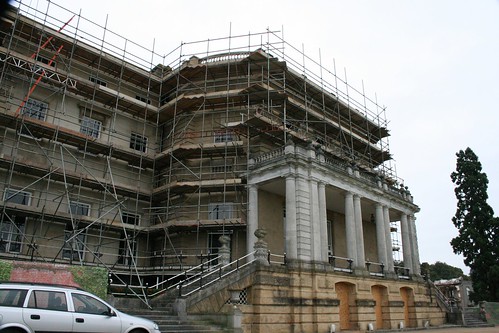
RAF Bentley Priory, or plain Bentley Priory as it is know called sits on a site that was on the edges of an actual priory that owned a vast swathe of land in the area from at least 1120 until the dissolution of the monasteries. The location of the original Priory was convenient for travellers being about a days ride from London at the time – and was described as being the “motorway service station” of the medieval era.
Following the dissolution, the Monarchy held onto the land, but eventually sold in 1766 to a military uniform supplier, James Duberley who built the core of the building. The building passed though several owners, who each added or amended the original building, including extra outbuildings. One owner even swapped the building around so that the grand front entrance became the private back garden, and a smaller front door built around the back.
Sold to the Air Ministry in 1926, it became eventually the headquarters for the newly formed RAF Fighter Command – which oversaw the Battle of Britain.
The Royal Observer Corps also moved to the building as they were a key component of Fighter Command and remained there right up to 1995, when they were disbanded following the end of the Cold War.
The site itself was finally closed as a military base on 31st May 2008 and was sold to a developer to convert into luxury flats.
Fortunately, the planning permission required that the ground floor and basement are converted into a museum, and the Bentley Priory Trust took a few people round the building site for a look at the conversion works.
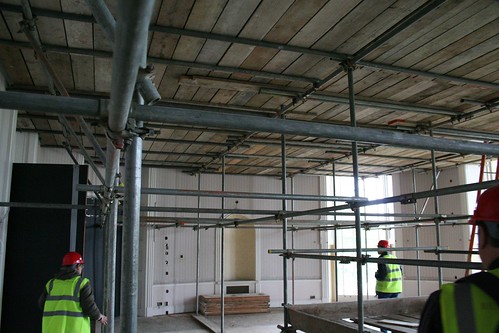
A brief talk about the history of the site and the usual admonishment to keep hard hats on, we went into what most people treat as the ground floor, although actually it is the 1st floor as seen from the original front entrance.
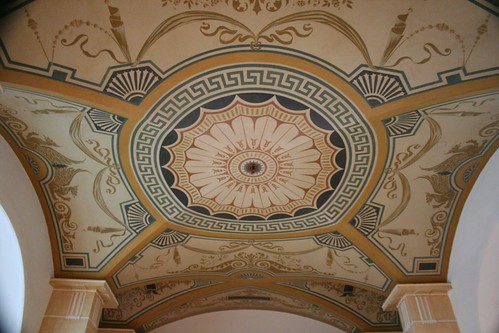
Time though to wander round to the current front entrance and admire the painted ceiling, which is almost perfect thanks to having been covered in whitewash at some point in its history and uncovered by the RAF when they moved in.
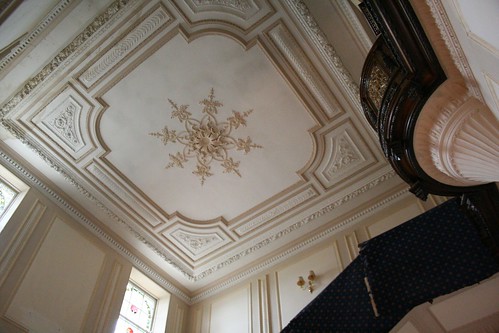
Sadly, the grand staircase was covered in carpets to protect it – but there is an interesting story here, as the staircase is actually a modern replica. During previous restoration work in June 1979, a disastrous fire tore through the staircase room and totally destroyed it – as well as damaging the surrounding rooms.
The replacement staircase was built, although some of the ornate iron work was replaced with plastic replicas by the cost-saving RAF, who were less beholden to heritage bodies than most of us would be.
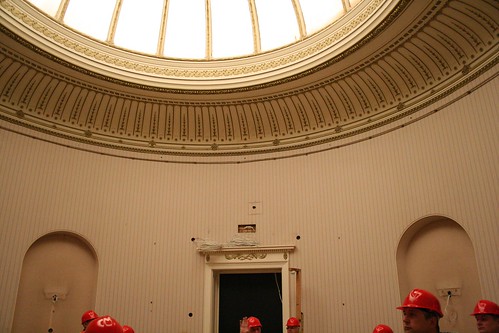
More impressive though down the corridor is the round trophy room which will be restored to its original function with the same paintings and trophies. The glass domed roof will also be replaced – as it turned out it is just a cheap plastic replica from that earlier mentioned fire.
A large side room is known as the dance room, although its original function was the first ever “ops room”, with a big map and women wandering round with big sticks and little model planes.
The ops room was eventually moved to a three-story bunker in the grounds. Sadly this was largely destroyed in the 1980s as a nuclear blast proof bunker was built – and that in turn is to be filled in. Various heritage people agree that there are better bunkers elsewhere, and while the cost of restoring it would have been huge, and I agree that other examples I have visited are better – I can’t help but think it would have added greatly to the museum as a place to visit.
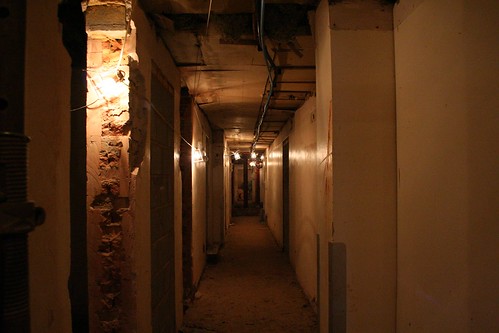
Downstairs though, and into what was the servants workspace. This will also be the museum space, although more utilitarian, with classrooms, a cafe and services – and in the large round space, a temporary display area.
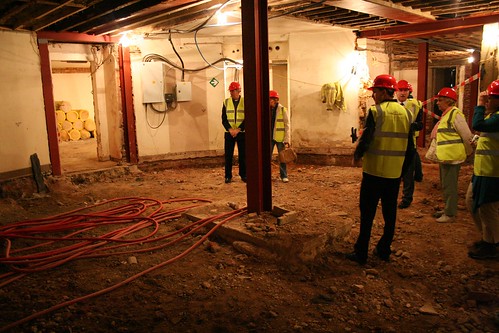
The current conversion of the building into flats is funding the building works for the museum, and they expect to finish late next year, with the museum opening in early 2013.
The museum though is still trying to raise money for its fit-out, and they still need a bit over £1 million for that.
You can read more about the charity handing the heritage here if you feel tempted to contribute to their fund raising efforts.
The full set of my photos in the gallery.



The sealing looks amazing! What about is this place?
Surely Frederick Gordon’s ownership of Bentley Priory (1882-1908) is worthy of a mention?
He operated it as a hotel (not particularly successfully), and had the Harrow & Wealdstone – Stanmore branch railway (closed in 1964 – I was taken on one of the last trains as a 5 year old) built to serve it.
A blog post mentioning everything would have been as long as the Wikipedia page I linked to.
I was saving the train line for another day though.
To whom it may be of interest. I’ve just realised that my maternal aunt Jemima Gertrude Louisa Neary (nee Bedwell, DoB 13/11/1896) must have worked at Bentley Priory during the 40’s. She lived in Kenton, Harrow with her husband William Neary and only daughter Patricia. I always knew my aunt was involved in something not really spoken about and retrieved from her belongings I have five different clear photographs of Bentley Priory in my possession, hence the link. I look forward to the opening of the planned museum in 2013. Maybe I will discover a record of her name in the historic files if there are any to be viewed. Mike.
When will the Batle Of Britain Museum be open to the public…Thanks Graham
I was on orderly cpl at stanmore park the night of the fire and had to call all the alarms,it was a sleeping duty but none was had tfat night
Hi all, I was just here yesterday with the developer and they gave me a look around site as I will be working here over the next few weeks.
The museum is due to open n September 2013 with HRH Prince Charles attending the official ceremony, I have to say the place is beautiful and the views from the south facing former main entrance over the city are breathtaking.
If anyone wants any more info, if I can get same, I will pass on.
I believe visitor numbers will be restricted to a max of 18,000 per year as some new buildings are being erected and reservations must be made in advance.
I was stationed at Stanmore Park in 1970 and worked in Bentley Priory it was the best time of my life. It is hard to explain to people who haven’t had the opportunity to work alongside such fantastic people. I don’t know if I like the idea of the property developers moving in but if I was offered one would definitely move in .
I too was stationed at Stanmore Park and worked at Bentley Priory and fancy meeting you here Jean Turner!! As you say it was a great place to work. Yet another landmark lost to the developer whom I hope treats it with the respect it deserves and about to view the results as I Google the transformation. Hope life is treating you well Jean.
I WAS very lucky to be able to clean at Bentley. I would have done the job free of charge. What a beautiful building and great people i worked with. I would love to go back and have a look around.
so proud to have worked there.
Josie. (Cleaner) or should i say very privileged person.
I worked down the hole 1971-1972 and 1975 to 1980 looking after the telecommunications equipment for the ComCen, HQ11 Gp and Operations Centre.
There are quite a few Facebook groups supporting Bentley Priory and Stanmore Park. Highly recommended for looking up colleagues and chewing the fat.
I visited Bentley Priory in 1942 whilst on my Radar course at Yatesbury . It really is a beautiful place and I visited it yesterday ,it has been made into a wonderful museum and brought back memories of all those years ago. I particularly liked the new additions and I am am sure it will inspire many a young lad to think of the RAF as a career. I was thrilled to see my photograph on the wall . I was stationed at Trelanvean Cornwall 1942/3 anyone recognize my name?
I was at Bently Priory 1956 to 1958 J/T Bright Drawing office worked under a civilian Mr Sheffield also had another civvy Mr Picard it was a great way to do National Service,remember we had a bus to transport us (23 draughtsman) we never did any parades being we were mostly J/T s or Corporal Techs we only performed orderly corporal duties
I had a wonderful childhood living in married quarters at Bentley Priory with mum and dad 1960 to 1966. Memories I will always cherish.