
As we edge ever closer to the 150th anniversary of the opening of the world’s first underground railway which is now just a couple of weeks away, it might be interesting to review some of the newspaper reports about how the construction of the railway progressed up to that momentous date.
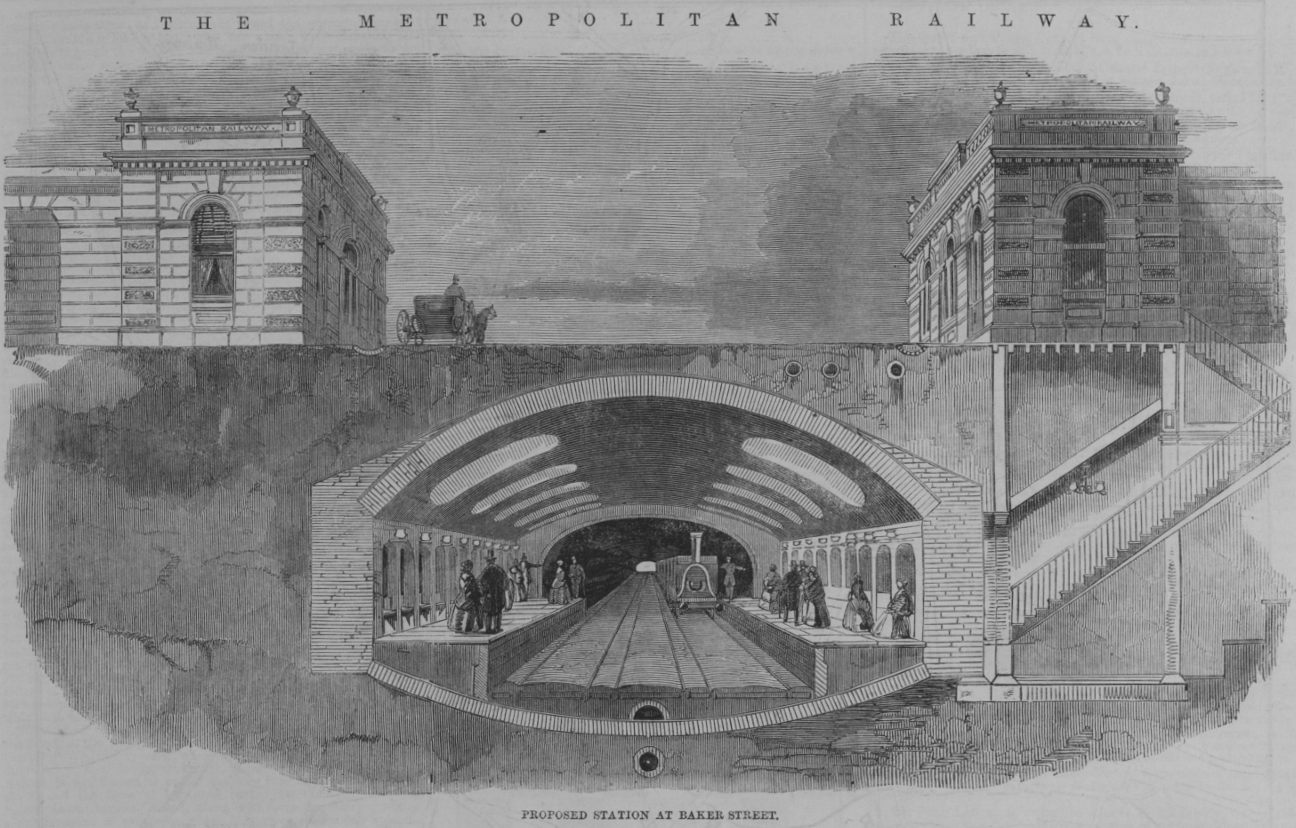
Below is an article from the Illustrated London News, with some illustrations. I am particularly struck by the side-elevation of Baker Street which shows why the station gained its remarkable profile, and despite being just one of several stations, it is often thought of as the most “authentic” of the original line.
The article also goes into detail about the steam engines, and how while they needed ventilation, they weren’t as bad as you might have expected from a normal steam train in the tunnels.
It was a curious article to type out, as it reminded me of my own scribbling on the topic of the Crossrail project. Maybe in 150 years time someone will be reprinting my articles and smiling at the quaint old-fashioned way of writing?
THE METROPOLITAN RAILWAY
This remarkable undertaking — which had been so long in abeyance that the public has well-nigh despaired of its ultimate accomplishment — has now been commend in earnest, and the contractors are proceeding vigorously with the works at various points. We have, therefore, collected a few details which we think will be of interest to our readers. The need of railways communication between the City and the great series of railway on the north of the Thames, both for passengers and goods, had been long grievously felt, but the difficulties in the way of carrying a railway into the the City appeared to be almost insuperable.
To have a railway, after the American fashion, passing through a densely-populous district, and crossing on the level our overcrowded streets and thoroughfares, was utterly out of the question; and scarcely less soto carry an unsightly viaduct through the heart of the Metropolis. The only alternative was that adopted by the Metropolitan Company — namely, that of an underground communication, by which the most densely-crowded districts could be traversed without the slightest annoyance or obstruction to the existing traffic.
A reference to the map will show that the railway starts from opposite the Great Western Railway Hotel at Paddington, with a fork up the South Wharf-road to join the Great Western Railway on the level, near the site of the old passenger station. The line then crosses the Edgware-road, and enters the New-road, which it follows to King’s-cross, it being one of the peculiarities of this railway that it occupies, throughout the greater part of its course, the under surface of the existing roadways, thus avoiding the enormous expenditure which would otherwise have been necessary for the purchase of valuable house property.
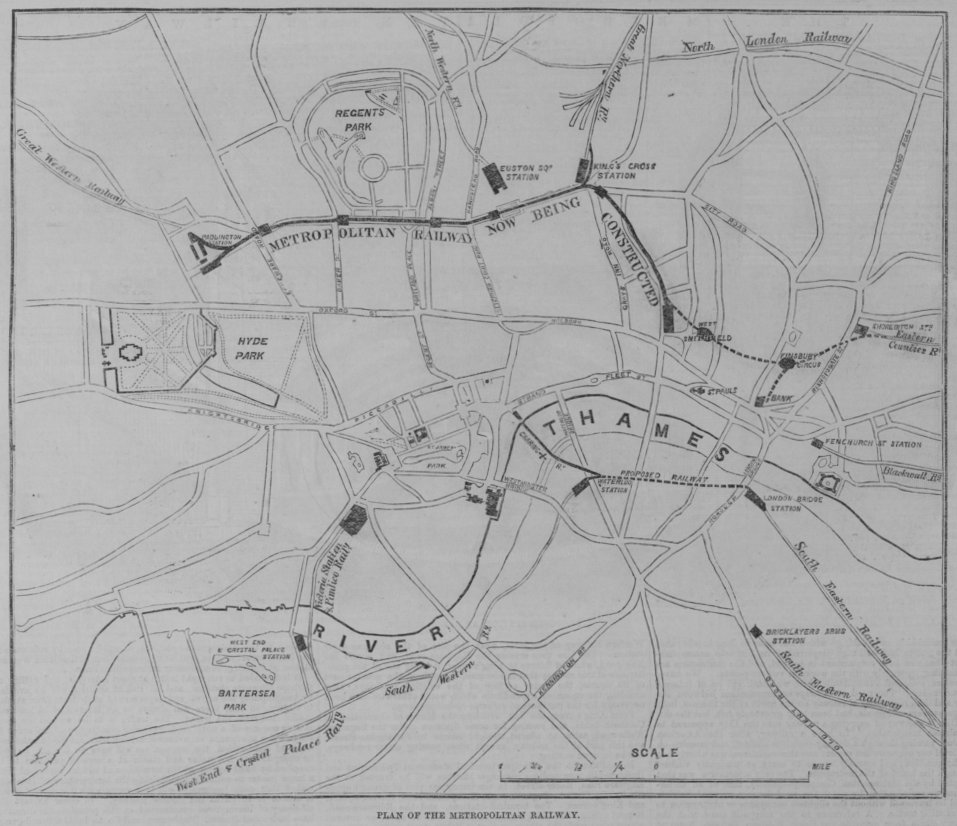
From King’s-cross, the line, avoiding the House of Correction at Coldbath-fields, and passing for some distance under the Bagnigge Wells-road, takes an almost straight course to Farringdon-street; and this part of the railway, except when passing under roadway, will be in open cutting.
In addition to the principle terminal stations at Paddington and Holborn-hill, commodious passenger stations will be erected at the Edgware-road, Baker-street, in the triangular plot of ground opposite Trinity Church, Regent’s-park, Hampstead-road, Euston-square and King’s-cross.
The terminal stations, and the Edgware-road, Regent’s-park, and King’s-cross stations, will be open, or covered with a glass roof; the others, as that at Baker-street (vide engraving), will be commodious, airy, and well lighted with gas. The ascent and decent to the underground stations, as will be seen by reference to the Baker-street station, will be no greater than at the Great Western station at Paddington and other metropolitan lines.
It is intended to run light trains as short intervals, and calling at perhaps alternate stations, and all risk of collision will be avoided by telegraphing the arrival and departure of each train from station to station, so that there will always be an interval of at least one station between the trains.
The traffic is to be worked by locomotive engines of a novel and ingenuous contraction. In order to obviate the annoyance in a tunnel arising from smoke and the products of combustion, the locomotive will have no firebox, but will be charged with hot water and steam at a certain pressure to be supplied by fixed boilers at the termini, and will be furnished with a large heater to assist in maintaining the temperature. it is estimated that each locomotive will thus carry with it sufficient power to enable it to effect the double journey. In order to test the efficiency of locomotives constructed on this principle the directors have instructed Messrs. Stephenson and Co. to build a broad-gauge engine, which will be employed in the construction of the works.
The general character of the archway may be gathered from the Engraving of the Baker-street station, and the mode of construction is shown by the Sketch of works as actually in progress at King’s-cross. The ordinary process is to open the ground, construct the archway, and then replace the surface. In this manner the whole of the New-road will be taken up and relaid in sections. This is not only a much cheaper process than of tunnelling, but it admits of the work being finished in a much more complete style, and rendered perfectly watertight.
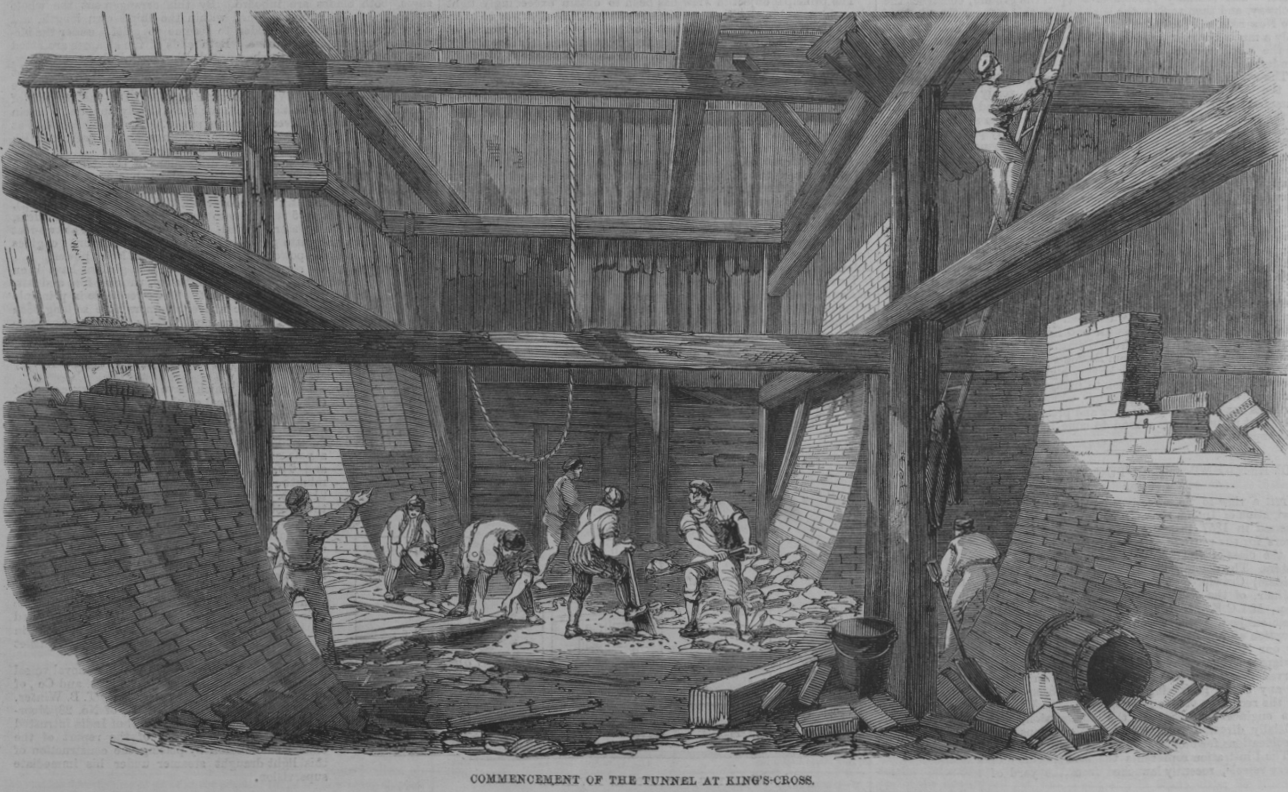
The works have been commence at the Great Western Station and at the Great Northern station to secure a ready outlet for the immense mass of excavated earth, gravel, &c.; and a large portion of the preliminary work of the reconstruction of the sewers has been already accomplished.
The directors are rapidly possessing themselves of the land, and there is every reason to hope that the commencement of the year 1862 will find the line open and in active work.
The company obtained their first Act in 1853, but the breaking out of the Crimean war, and the disturbances of the monetary system resulting therefrom, rendered it impossible to obtain the capital necessary for carrying out the undertaking. After many unsuccessful efforts in various directions the directors succeeded in obtaining the necessary assistance from the Corporation of London, who became shareholders to the extent of £200,000.
The capital of the company consists of £850,000, in shares of £10 each: of this amount £200,000 is held by the Corporation, £175,000 by the Great Western Railway Company, and the remainder by the general public. The contractors are Messrs. Smith and Knight, and Mr. Jay, both firms being well known in connection with works of this description. Messrs. Smith and Knight are constructing the western portion of the line from Paddington to Euston-square, and Mr Jay the eastern portion from Euston-square to Farringdon-street.
We are informed that early in May a grand demonstration will be made at the Paddington station to inaugurate the commencement of this undertaking, which, as regards its bearing on the comfort and prosperity of this great metropolis, is second to none in interest and importance.



Re the locomotive design, if they did not have a “boiler” (to prevent pollution), what kind of “large heater” is meant by “the locomotive will have no firebox, but will be charged with hot water and steam at a certain pressure to be supplied by fixed boilers at the termini, and will be furnished with a large heater to assist in maintaining the temperature”?
IanM
The heaters were still coal fired, but needed far less coal than normal, and also they condensed the steam to reduce emissions. It still put out a fair amount of steam, hence the need for ventilation points along the underground – but they put out a lot less than a conventional steam engine.
It’s referring to the prototype locob nicknamed ‘Fowler’s Ghost’ – i think the idea was to use firebricks to retain enough heat for steam production when underground. It was a dismal failure, barely capable of moving itself, and conventional steam loco’s were hurriedly built by the GWR for the first trains. These, like the later Metropolitan loco’s, ‘condensed’ by putting the exhaust steam back into the tanks but this obviously did nothing for the smoke.
Chris
I did not realise the the twin Paddington stations were an original feature of the railway. Does anyone know the rationale for this? Possibly they were already contemplating westward expansion or a fork in the line?
Probably more due to the need to have somewhere to park the trains overnight above ground.
The article mentions new stations at trinity church and regents park. Where were these supposed to be? I assume Hempstead rd is great Portland st?
Hampstead road is where Warren Street exists today. I presume it was abandoned during planning/construction as being too close to Euston Square.
Trinity Church is today’s Great Portland Street.
Here in East Germany locos filled with steam were used within the ‘Mibrag’ lignite coal works. The danger of explosions was extreme because of the process that was used to create bricks of coal from powder.
There is oneon displayat Merseburg station.