Browsing the blog archives for February, 2007.

The Waterloo and Whitehall Pneumatic Railway

subterranean stuff

You may have read about “secret tunnels” under Whitehall, and indeed there are some - but here is a tale of one that is not exactly a secret - more just forgotten.

The Waterloo and Whitehall Pneumatic Railway was a air piston based railway service which was expected to link Great Scotland Yard at Whitehall with Waterloo on the southern side of the river.

It was a piston based railway, leading on from earlier works with hydraulic parcel chutes in the City, and a test passenger train platform built at Crystal Palace.

Construction of the scheme began around 1865, but ceased in 1868 following a banking crisis which resulted in one of the main financial backers going bust.

Exact details of what was built seem confused – but it now seems that the tunnel from Great Scotland Yard to the river was actually built.

The river was also dredged at that point, and possibly brick foundations might have been laid along part of the under-river route.

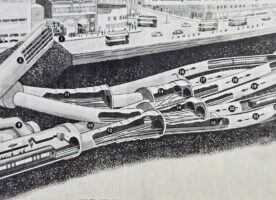
There is an lithograph I found on the rather excellent british-history website which shows the Embankment cross section at what looks like Charring Cross showing off the Bazalgette sewer system and District train lines – with the Pneumatic Railway in place – but judging by the records, I can only presume that this is a projected side-view of an expected future, as the picture shows the tunnel going under the river itself, and I can’t find any record of that bit actually being built.

However, studying the picture shows that there is indeed the early Hungerford Bridge and Charring Cross station, leaving me in no question that the deeper tunnel is the expected pneumatic railway as discussed above.

The tunnel itself would have been a brick-lined pipeline of diameter 18 (or in some records, 13) feet, and the air pumping station would have been at Waterloo.

Now, here is the question – how much of that quite deep tunnel still exists, and can we get into it :)
I am quite interested in this, and will be doing more hunting in the archives to see if I can find some maps and more exact information. The thing with the Victorians is that they were incredibly detailed record keepers, so if you find the files, then the detail is considerable. Alas, most of the records are often lost, and then you can hit a bit of a black hole.

As an aside, the Tower Subway tunnel (and which I can’t get into - sobs) which was built a few years later had also considered using pneumatics, but later settled on a chain to pull carriages along the tunnel length. This was removed only a couple of years later and the tunnel converted into pedestrian use.

http://www.british-history.ac.uk/image.aspx?compid=45233&filename=fig85.gif

The large tunnel running left/right and marked “4” is the Waterloo and Whitehall Pneumatic Railway, as it would have been.

No Comments

Don’t forget the pancakes on Jif Lemon Day!

Random

Today is Shrove Tuesday, better known as Pancake Day - or in the UK, in irony - often referred to as Jif Lemon Day.

jif_lemon.JPGJif Lemon is a quite weird product. It is a small plastic “bottle” in the shape of a lemon, and contains lemon juice along with a gazillion preservatives etc.

Quite why anyone would use Jif Lemon instead of a real lemon is beyond me, unless you use a tiny splashes of lemon juice over a long time frame.

That said - I hugely admire the company. They managed to turn a rather odd product into what is almost a cultural icon.

So, why does it still sell?

I think it is a mixture of different issues.

Firstly, the product was actually quite popular when I was a kid. For me, Pancake Day would always include Jif Lemon - as it fitted the social opinions of the time which favoured processed food over fresh.

Today, we (fortunately) have learnt the errors of that and aim to eat as much fresh food as possible - so why does this little bottle of processed lemon juice still sell in such vast quantities.

I think the genius was about a decade ago, when the company came up with its infamous marketing slogan…

“Don’t forget the pancakes on Jif Lemon Day”.

They bucked the general advertising trend which was to spread a brand appeal over as wide a range as possible - and actually focused it on just one event - Pancake Day.

In doing this - they made the product synonymous with Pancake Day - and guaranteed its future.

So many brands which tried to spread out their appeal to more and more markets actually lost focus and faded, but not that dear little yellow bottle, which today is utterly focused on just one event a year.

In doing so - I am willing to bet that they sell more in the week leading up to pancake day than if they had tried to remain the all round replacement for fresh lemons.

So, why do I still buy this little bottle once a year? Partly, the irony of it all - but also as it is now so utterly linked with the pancake event, and it is also a dose of nostalgia for when my parents would buy the same small bottle.

Kids growing up today will also forever associate Pancake Day with that little yellow bottle, as their parents buy it each year in memory of their own childhood.

In a hundred years time, people will still go out and buy a small bottle of processed lemon juice as each generation passes the tradition down to the next.

Not a bad result for a small plastic bottle, and as awful a concept as the product is to our modern eyes, long may it continue to dominate Jif Lemon Day.

Here is a little weblink to a video showing how Jif Lemons are made.

http://www.unilever.com/ourcompany/newsandmedia/videolibrary/foods/jif.asp

1 Comment

The Hole in The Wall

Random

Near Hyde Park, many years ago I found this rather charming local feature - and recently, I finally remembered to take a camera and photograph it.

I originally found it when doing one of my random wanderings around, where I just start walking down side streets to see what is there - and found this gap in a wall.
img_1773.jpg

Basically, the area between Hyde Park and Knightbridge was split into two great estates, and a wall seperated them. As Knightsbridge built up as a shopping destination, this wall made it difficult for residents of the Rutland Estate side of the wall (the Northern side) to get to the shops without a fairly significant journey around going up to Hyde Park, then around to Knightsbridge.

During World War 2, a German bomb landed nearby and the wall was demolished in the explosion.

Suddenly, residents could walk the 100 yeards to Knightsbridge without having to take the mile or so detour!

After the war, the locals petitioned to keep a right of way through the replacement wall - and hence the “Hole in the Wall” as it is known came to be. While I found it by random chance, it is actually quite heavily used by local people who know about it.

A small sign was put next to the wall in 1998.

img_1772.jpg

Admitedly, architecturally - this is quite a irelevent - it is just a hole in the wall finished with brick linings and some steps.

But I just love the little story, and I am really pleased that the council put up a small sign so that anyone who stumbles across it as I did can read this odd little tale.

Another photo, from the Knightsbridge side showing the steps. I am sure that if this was built today, they would have to have a long slope for “disabled access”. That would have spoilt its charm.

img_1775.jpg

If you want to find it - the North side address is Ennismore Street, alongside Rutland Street which is on the South side of the wall. This Google Maps link is close to the Hole.

2 Comments

It takes a month to remove me from a mailing list?

geekery, rants

As I prepare to leave my current employer, one of my tasks is to start closing down all the various newsletters I subscribed to as part of my work. So, I dutifully click on the unsubscribe links on the emails.

Now, these are automatic processes - I click a link, it loads a webpage and a database is updated. Very simple - or so it seems.

I can tollerate maybe a 24 hour delay in the database being updated, although I don’t really see why that should be the case - but it is tollerable.

What is not acceptable is when a large reputable firm trys to take a month to remove my name from their database! What do they do over there? Manually edit a 16th century parchment using quill and ink?

Good grief guys - this is the modern age, it does not take a month to update your databases.

To add insult to injury, after I clicked to remove my name and got the screenshot below - they actually sent me another email.

This is really poor customer care - and had I been a discontented customer, sending me more marketing messages after I had asked you to stop is really bad, and liable to have people clicking on the “report this as spam” button.

What will that do for their deliverability past spam filters.

untitled.jpg
1 Comment

Ribblehead Viaduct

Random

I am advised that the famous Ribblehead Viaduct will be closed on the 22nd July, and it “may” be possible to walk across it.

An odd mix of train anoraks and architecture fans - on that day, there will be no trains.

Would people be interested in a visit and wander if possible?

Thinking maybe a weekend, maybe using Carlisle or Leeds as a base and taking in a rail journey the day before on Settle-Carlisle line which is said to be one of the most scenic in the country.

The 72 mile route from Settle to Carlisle takes you on a journey through the magnificent Yorkshire Dales, over the 24 arches of the Ribblehead Viaduct before plunging in to the longest tunnel on the line at Blea Moor. Emerging onto the side of Dentdale, the line leaves the Dales at Garsdale and makes it way through the gentle, lush rolling hills of the Eden Valley, with rural villages and market towns before arriving at the great border city of Carlisle.

I’ll keep an eye on this development, and if it does happen, will send out a message to the mailing list.

No Comments
« Older Posts